The Electrical Substation, Deflategate, and an ‘Independent Scientist’ by Peter Cowan
One unnamed scientist. No public report. A number that doesn’t say what the 49ers think it says — and the firm whose business model depends on the belief that it does. The NFL has run this play before.
https://peteranthonycowan.substack.com/p/the-electrical-substation-deflategate
Personal Insertion of NoATT.blog host: It was an electric substation 250 yards from our home that sent 3 women into fertility issues. The young “first time” mom who lived 75 yards from it gave birth to a still born. Relative to this article, I know of 2 women who had a prolapsed uterus (weakened tendons?) who both lived close to it. They plopped one down in the center of this town. I’m always try to determine if we’re into evil or just criminal levels of ignorance or ignore-ance for profit. Come on humans. We can do better than this but we need to start holding some people accountable in a big way…as a deterent to future profiteers.
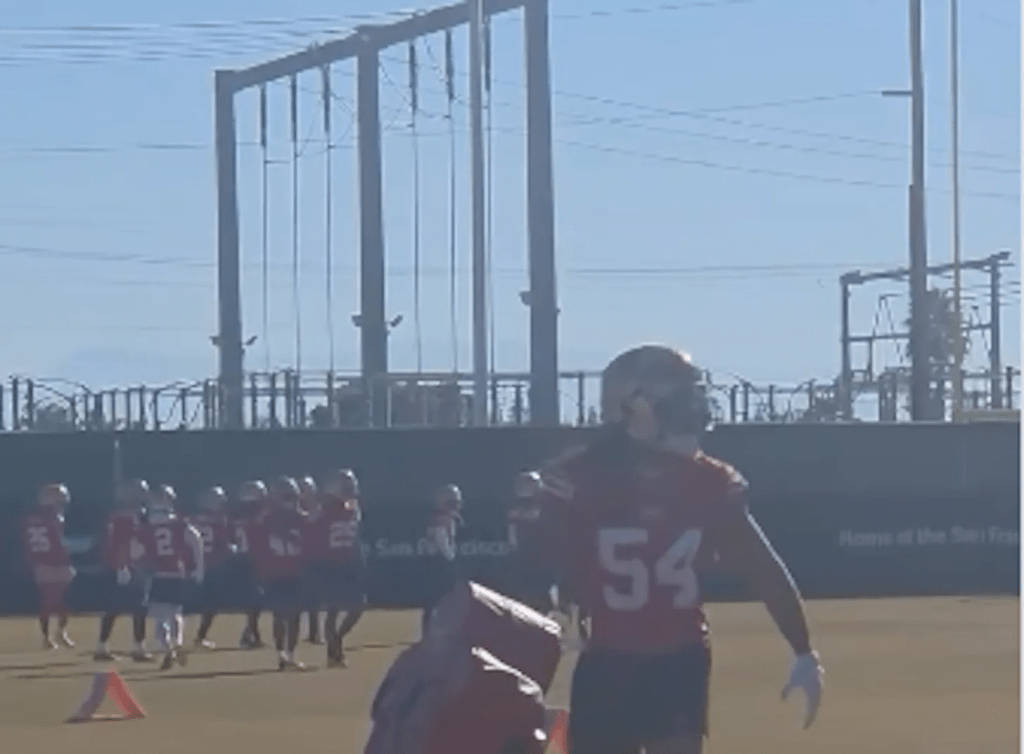
On Sunday morning, March 29th, 2026, while NFL owners, GMs, and head coaches were gathered at the Arizona Biltmore fielding questions about replacement referees, tush push rule changes, and the pending Seahawks ownership vote, 49ers General Manager John Lynch squeezed in a 23-minute conference-room session with local, Bay Area media and dropped the results of the 49ers’ substation study.
The scientist they hired — unnamed, credentials unverified by anyone outside the organization — examined the facility with what Lynch called “lab-grade equipment” and returned with what Lynch described as a “big nothing burger.” The levels from the substation were, he said, “400 times less than an unsafe zone.” A normal place of work. A normal gym. The exposure levels, the scientist found, were comparable to — in his words — “running a vacuum cleaner or a hair dryer”. Lynch also said no free agents or their representatives had raised the substation as a concern during negotiations.
The Mission Substation is a municipal electrical facility operated by Silicon Valley Power, Santa Clara’s city-owned utility — it has three transformer banks rated at 50 megavolt-amperes each, for 150 MVA total, the largest substation in the SVP system. It sits at the northeast corner of the 49ers’ Marie P. DeBartolo Sports Center, adjacent to the training facilities where players train daily. It was not always there. The old Tasman substation, which it replaced, sat in what is now a remote parking lot — well away from the facilities. The new Mission Substation was built to power Levi’s Stadium and the surrounding high tech infrastructure in the heart of Silicon Valley, completed in May 2014, weeks before the stadium opened, and placed directly behind the facilities where players train.
My hypothesis, developed across several installments of this series, holds that chronic exposure to the substation’s electromagnetic fields (AC magnetic fields and high-frequency transients, commonly known as ‘dirty electricity’) is systematically weakening players’ connective tissue — both triggering collagen degradation and suppressing synthesis of new collagen, that break down the tendons and ligaments players depend on — producing an injury pattern no other variable unique to the 49ers adequately explains. The 49ers have ranked among the league’s most injured teams for a decade, with an unusual concentration of tendon and ligament ruptures. My investigation generated over 22 million views on X and widespread international media coverage — the New York Times, the Washington Post, ESPN, NBC News, CBS Sports, Sports Illustrated, the Daily Mail, Mundo Deportivo — as well as discussion on Joe Rogan, Bill Simmons, and Skip Bayless — eventually prompting the 49ers to commission the assessment announced by Lynch.
The timing was convenient. Lynch was in Phoenix, physically available to any reporter who asked, but every beat writer at those meetings was chasing 31 other stories before Roger Goodell’s Tuesday presser. March Madness was in full swing and Elite Eight Sunday was consuming the sports media oxygen that afternoon, with regional finals starting at 1 p.m, and MLB had just started its season. The announcement came planted in the lull after the initial NFL free agency frenzy — which included the return of Dre Greenlaw who famously tore his Achilles tendon running in from the sidelines in Super Bowl LVIII — and before the start of pre-draft coverage, the quietest stretch of the NFL calendar outside of June and July. The announcement wasn’t buried but it was barely audible, and the press that did cover it took the conclusion at face value — declaring the “viral theory” resolved, without even asking any questions. Lynch directed reporters to ‘Corry, for further details’. Corry Rush is the 49ers’ Vice President of Communications. While some reporters did follow up with Rush for additional context, none appear to have questioned the methodology or to have seen the report itself.
I contacted both the 49ers’ press office and Rush prior to publication. Neither responded.
Theodora Scarato, Director of the Wireless and EMF Program at Environmental Health Sciences, was less satisfied:
“Why the secrecy? Why is the information not being shared? They should share the results and the expert involved with full transparency. To say it is a nothing burger without the facts is not justified. Where is the data? Where is the beef in this ‘nothing burger?’” – Theodora Scarato, Director of the Wireless and EMF Program at Environmental Health Sciences
This report also followed a pattern the 49ers have established in their ham-handed handling of this issue. One scientist. No name. No published document. A single quote describing the conclusion. Meanwhile, the team announced $9 million in facility upgrades: hydrotherapy expansion, three new physical therapists, individualized care. Cosmetic remedies for an injury record the team has failed to explain.
There is an irony in all of this. The 49ers are not the perpetrators — they are the victims. The substation belongs to Silicon Valley Power. The 49ers are a football organization — SVP is a power organization, and when the utility’s framework says it’s safe, there’s no obvious reason for the 49ers to push back. As we’ll see, accepting that framework meant defending the utility’s interests against their own players’ health.
Lynch’s quote contained a number — ‘400 times less than unsafe’ — and that number tells us something very different than what he intended.
The Number
“We’re safe. We’re in a safe place of work, the levels I think I read [in the report] are 400 times less than unsafe zones. So it’s a normal place of work, it’s a normal gym. We are safe, we’re healthy and we feel really good about that,” John Lynch told reporters at the annual NFL league meeting.
“400 times below unsafe.” Let’s examine that number.
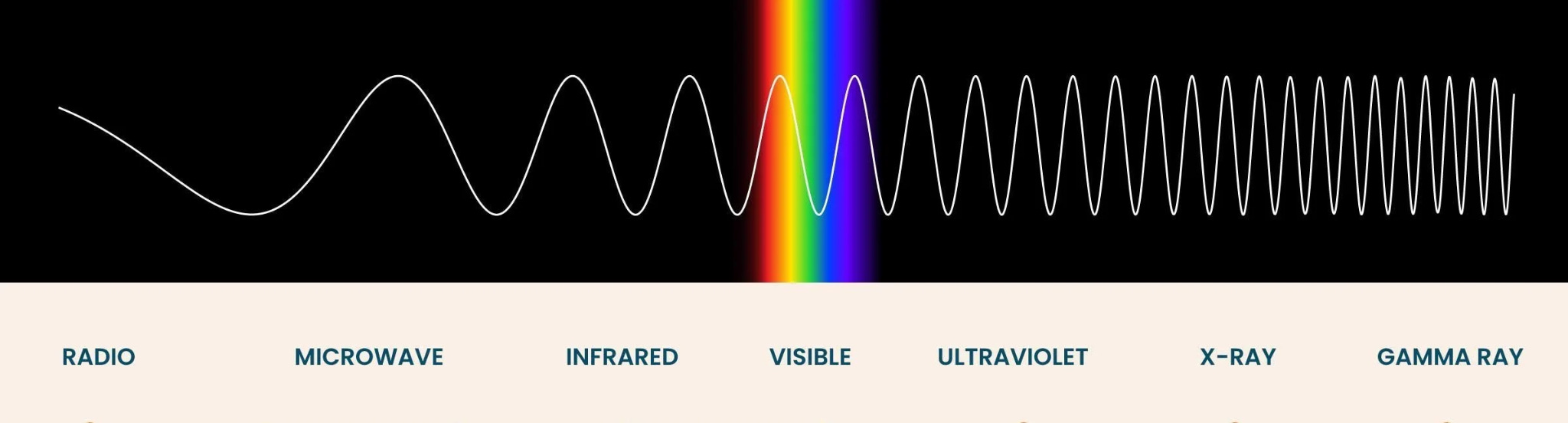
Electrical substations operate at 60 Hertz (Hz) — sixty cycles per second — producing what physicists call extremely low frequency (ELF) magnetic fields. This places them at the far lower end of the electromagnetic spectrum, well below radio waves, microwaves, and far below the ionizing radiation of X-rays. ELF fields pass through walls and most building materials, and unlike radio waves, their intensity drops rapidly with distance. The Mission Substation sits yards from the 49ers’ training facility. Distance helps — but it doesn’t eliminate the field.
The primary regulatory standards for 60 Hz power-frequency magnetic fields are set by two bodies: ICNIRP, the International Commission on Non-Ionizing Radiation Protection, a nonprofit standards-setting advisory body; and IEEE, the Institute of Electrical and Electronics Engineers, maintained by the industry-based International Committee on Electromagnetic Safety (ICES). Both are cited in health-based regulatory assessments, though they reflect different priorities, as we’ll see. ICNIRP’s 1998 standard set the occupational ceiling at 4,170 milligauss (mG); in 2010, ICNIRP revised upward to 10,000 mG.
Four hundred times below 4,170 mG is roughly 10 mG. Four hundred times below 10,000 mG is 25 mG. On December 1, 2025, I stood at the fence line of the practice field at the 49ers training facilities, 100 yards from the Mission Substation, and measured the magnetic fields at 11 a.m. on a quiet Monday — what power engineers call “low load,” meaning off-peak demand, when the grid isn’t under pressure and fields run lower than they would during peak demand. Summer months, when training camp opens and air conditioning loads surge across Silicon Valley, are when the electrical load draws hardest on the grid. My gaussmeter read 8.5 mG at the fence line.
Silicon Valley Power (SVP), the municipal utility that operates the substation — the largest in the system — serves not only the stadium complex, its on-site data center, the dark fiber network running through the facility, and the distributed antenna system powering connectivity for 70,000 fans on game days, but a rapidly expanding cluster of commercial data centers drawing on the Northern Receiving Station’s 230/115 kV capacity — making Santa Clara one of Silicon Valley’s primary power hubs. The grid is substantial, and so is what it produces.
Extrapolating from Lynch’s statements and those standards, the scientist measured right in that range. Lynch’s scientist and my gaussmeter are describing the same environment.
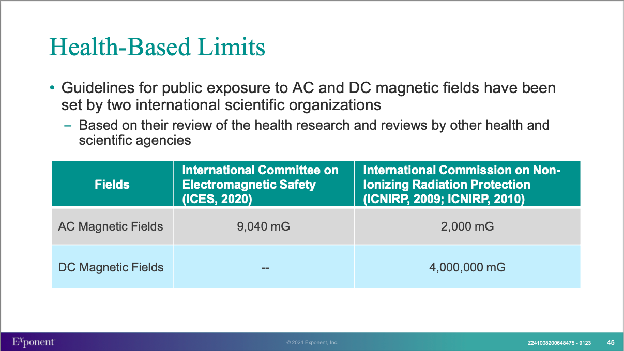
The other standard is IEEE C95.1-2019. Unlike ICNIRP, IEEE is an industry standards body, rather than a general standards-setting advisory one, and its limit reflects a different set of priorities. Its general public limit sits at 9,040 mG — four hundred times below that is 22.6 mG, which lands inside the field range already estimated for the 49ers facility interior on a normal training day. Its occupational whole-body limit at 60 Hz sits at 27,100 milligauss. Four hundred times below that is roughly 67 mG.
The numbers that bookend the ICNIRP standard — 10 to 25 mG — bracket exactly the range my original estimates predicted: 13 to 21 mG. Those estimates were calculated from my 8.5 mG fence-line reading, combined with public capacity and load data for the Mission Substation — independent work published in January 2026, months before Lynch stood in that Phoenix conference room.
He commissioned a study to evaluate my field estimates and presented it as a rebuttal. It confirmed them. The IEEE occupational number — 67 mG — is a separate question entirely, and a more troubling one.
File both sets of numbers from both standards away for now. The standards exist, and someone maintains them.
Even the Most Charitable Reading Doesn’t Clear
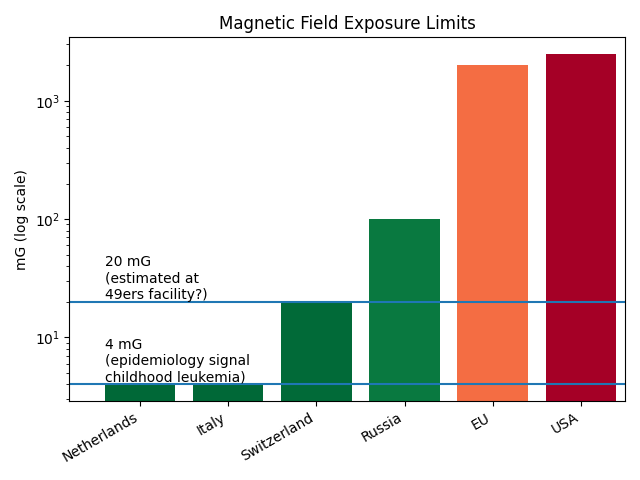
Let’s give the 49ers every benefit of the doubt and assume the scientist used the general public exposure ceiling rather than the occupational standard. That assumption is incorrect — players training daily in that facility are occupationally exposed by any reasonable legal definition — but let’s assume it anyway. The general public ceiling is 2,000 mG. Four hundred times below that is 5 mG.
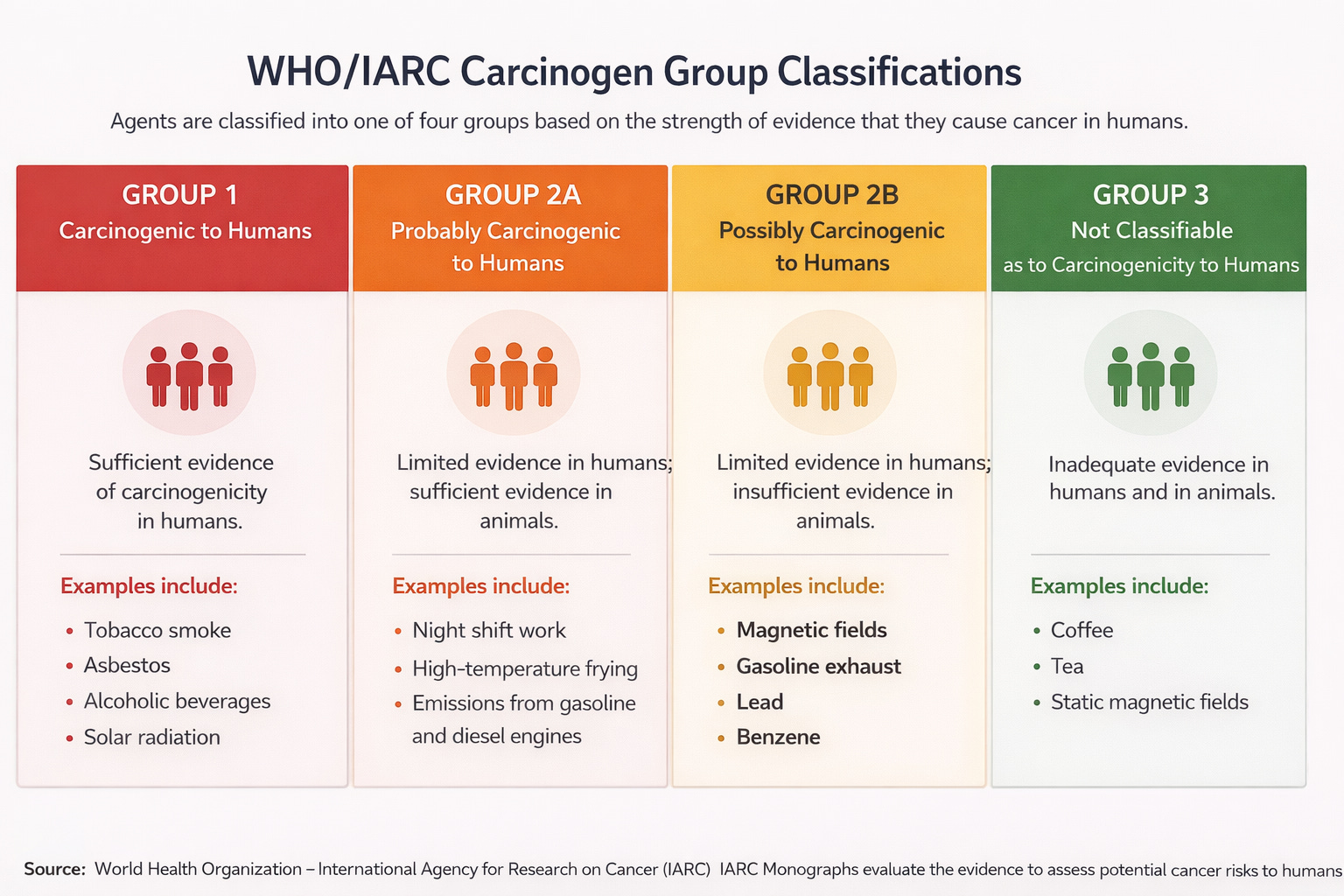
5 mG is still above the threshold that matters for chronic exposure. The World Health Organization’s (WHO) International Agency for Research on Cancer (IARC) classified extremely low frequency (ELF) magnetic fields as a Group 2B possible carcinogen in 2001, based on epidemiological studies observing elevated childhood leukemia risk above 3 to 4 milligauss. The most generous possible reading of Lynch’s own number still lands above that threshold. The cancer classification was not the only concern raised by that body of evidence. California’s Department of Health Services conducted its own EMF risk evaluation in 2002 and concluded its scientists were inclined to believe the same exposure range increases risk of childhood leukemia, adult brain cancer, Lou Gehrig’s Disease, and miscarriage.
Scarato, whose contribution to a 2026 CRC Press volume on the impact of anthropogenic activities on the natural environment, has documented international EMF policy approaches, has noted that ICNIRP and IEEE limits primarily address short-term acute effects — nerve and muscle stimulation — and do not address cancer risk or long-term exposure health impacts. Some governments, per Scarato’s review, have drawn different conclusions from the same evidence: the Netherlands has had policies in place since 2005 to reduce ELF magnetic fields in homes, schools, and kindergartens, with the government even buying up homes under high voltage power lines due to the EMF exposure. The UK promotes a precautionary approach through Engineering Recommendation G92 — industry-endorsed best practice rather than statutory law, but adopted by network operators — including engineering measures to reduce net currents and guidance recommending substations be sited away from homes. Yet, no federal regulations or public heath recommendations exist in the United States — the EPA was defunded from developing such safety limits decades ago.
There is also a lack of transparency. Like the 49ers training facility, measurement data of magnetic field levels from powerlines and substations are often not publicly disclosed, or are buried deep within technical reports, leaving affected communities in the dark. Scarato notes that, as a result, most people in the United States have no knowledge of the EMF levels they are exposed to in their homes, schools, or communities.
Engineers are aware of this. In practice, independent of regulatory requirements, they routinely recommend shielding above 20 mG — not because any official ceiling requires it, but because of the known cancer association. The official occupational limit is 10,000 mG. The more lenient IEEE threshold sits at 27,100 mG. Engineers routinely shield at 20 mG. The gap between those two numbers is its own kind of admission.
So even within the framework Lynch’s scientist used, the number doesn’t establish a safe working space. Which brings us to the larger problem.
The Framework Is the Wrong Ruler
ICNIRP and IEEE standards were designed to prevent a specific thing: nerve and muscle stimulation in healthy adults during short-term exposure to strong fields. They were acute exposure limits, built around a thermal model of biological harm. That model has a clear mechanism and a clear threshold: fields strong enough to induce current in tissue, heat tissue, and stimulate nerves. Below the threshold, the acute model says nothing happens.
What the acute model was not designed to address: chronic non-thermal biological effects — voltage-gated calcium channel activation, which disrupts the chemical signaling cells use to regulate their basic functions, and disruption of the body’s own bioelectric signaling — including the mitochondrial membrane potential that drives cellular energy production, leading to oxidative stress cascades that activate enzymes capable of breaking down connective tissue — accumulating in athletes spending thousands of hours per year in a biologically active magnetic field over multiple seasons. Applying an acute exposure ceiling to a chronic exposure question is a category error. The ceiling is real, it just doesn’t measure what is being asked.
The hair dryer comparison makes this tangible to the average person. A hair dryer runs at 300–700 mG — yes, far above a substation’s 20 mG — but for a couple minutes at most. The comparison shifts attention from duration to peak intensity, which is exactly what the acute model measures and the chronic model does not. An NFL player spends many hours a day, two hundred days a year in that facility. No one is exposed to a hair dryer to any similar extent.
The hair dryer comparison deserves a closer look. The Mission Substation has a total capacity of 150 megavolt-amperes. That is the equivalent of roughly 100,000 hair dryers running simultaneously. Lynch’s scientist compared the players’ exposure environment to a single one — and even if the field attenuates significantly by the time it reaches the practice facilities, what remains bathes the entire body, continuously.
But the magnitude isn’t even the most misleading part. A hair dryer is a point source — its field radiates outward in all directions and drops to negligible levels within a foot. A substation is not a point source, it is part of a circuit. Current flows out through the transmission lines and returns through the ground, and that return path runs beneath and around the entire facility. Players aren’t standing at the edge of a field that dissipates outward — they may be training directly above or beside the return path of the current, inside the field rather than at its periphery.What that return current is carrying through the ground is a separate question entirely.
The number Lynch cited may be accurate, but the framework used to call it safe is not built for the question being asked.
The Company Behind the Conclusion

The league has a pattern. When controversy arises — a player’s health, a coach’s conduct, a workplace investigation — the NFL commissions an “independent inquiry”. Inquiries are conducted by investigators retained and paid by the league, that typically produce conclusions that minimize NFL liability, and are often shielded from public scrutiny. This pattern is structural, not incidental, and was most vividly displayed in the NFL’s decades-long denial of the link between football and brain damage — but for our purposes, there is a closer parallel.
In 2015, the league needed an independent investigation into whether Tom Brady and the New England Patriots had deliberately deflated footballs before the AFC Championship Game. It hired outside investigator Ted Wells of the law firm Paul Weiss to lead the inquiry. NFL general counsel Jeff Pash reviewed drafts of the report and provided comments throughout — a fact Wells later confirmed under oath. Paul Weiss, in turn, hired Exponent, Inc., a California-based scientific consulting firm, to produce the analysis. Exponent’s 98-page report concluded that the pressure drop in the Patriots’ footballs could not be explained by environmental factors alone. Brady was suspended for four games. The Patriots were fined $1 million and stripped of two draft picks. Outside researchers disagreed almost immediately, and later proved the report wrong — the pressure drop was fully explained by basic physics.
That same NFL now tells us its practice facility got a clean bill of health. The scientist, they say, is “independent”.
David Michaels, former head of OSHA under President Obama, gave a name to the broader practice in his 2008 book Doubt Is Their Product: the systematic manufacture of scientific uncertainty to delay regulatory action on harmful products — drawing the title from a tobacco industry internal memo: ‘Doubt is our product, since it is the best means of competing with the body of fact that exists in the minds of the general public.’ Exponent is not the only firm in this ecosystem, but it is one of the most prominent. Dr. Devra Davis — epidemiologist, toxicologist, member of the Nobel Peace Prize-winning IPCC scientific team, and author of more than 220 scientific publications — called the network ‘The Truth Machine’ and identified Exponent as one of the central mechanisms: a firm deployed to ensure that no body of evidence ever became conclusive enough to force regulatory action.
Scarato put it plainly:
“Exponent is a classic ‘science-for-hire’ product defense firm … and [it] is widely used by the energy industry as a go-to consulting firm for ‘expert’ testimony defending against claims of human and environmental harm, while promoting the illusion that magnetic fields are 100% proven safe.”
Exponent was founded in 1967 by Stanford professors and engineers to investigate industrial accidents and product failures. The firm is now publicly traded, with almost $600 million in annual revenue and roughly 1,200 employees. Its business model depends structurally on manufacturers facing liability — the firm said so itself, disclosing in its 2015 SEC filing that reduced corporate exposure to lawsuits would “significantly reduce” demand for its services.
Exponent’s Silicon Valley headquarters is at 149 Commonwealth Drive in Menlo Park — roughly sixteen miles up highway 101 from the 49ers training facility. The firm has a documented relationship with Silicon Valley Power (SVP), the municipal utility that operates the Mission Substation adjacent to Levi’s Stadium. In 2024, when SVP proposed a new transmission line through Santa Clara and residents raised health concerns, the city consulted Exponent’s Dr. Gabor Mezei — a principal scientist in Exponent’s Health Sciences practice who previously directed EMF research at the Electric Power Research Institute (EPRI), an organization funded by electric utility companies to produce research on their behalf. He concluded the evidence does not confirm adverse health effects from power frequency EMF.
The 49ers needed a scientist to evaluate the substation that SVP operates. Exponent had already been doing exactly that work — for SVP. Yet rather than investigate the exposure independently, the team adopted the power industry’s own framework and its own conclusion — defending, in effect, the utility’s interests against their own players’ health.
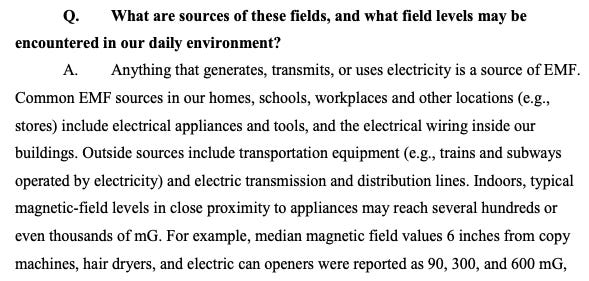
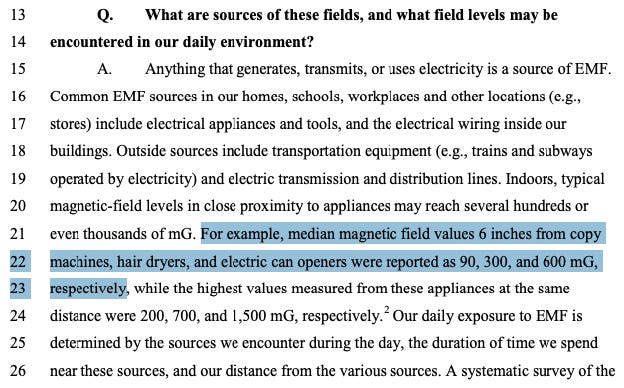
In prefiled testimony before a New Hampshire evaluation committee about magnetic field levels near a proposed transmission line, one of Exponent’s senior scientists assured regulators that exposure levels were less than you’d get from a “hair dryers and electric can openers” and similar to what would be found “in our homes, schools, and workplaces.” The same language as the 49ers report — nearly word for word.
The “Independent Scientist”
Lynch described the researcher as independent, with more than 45 years of experience. We know only what he and the team said publicly: lab-grade equipment, 400 times below unsafe, typical work place, and exposure comparable to a vacuum cleaner or hair dryer — language that came not from Lynch at the podium but from the report itself, relayed through the team’s communications office. According to media coverage on the study, that person tested the practice fields, weight room, cafeteria, locker room, and meeting rooms — anywhere the players go.
There are only a handful of researchers in the United States who meet that description — operating within the regulatory and standards ecosystem this series has documented, with careers long enough to predate 1980, and who routinely frame their testimony around household appliance comparisons. Lynch said more than 45 years. Mezei — the Exponent scientist with the direct connection to SVP — has 25. That single number eliminates him.
Within Exponent’s Health Sciences practice, there is a group that specializes specifically in electromagnetic fields — exposure modeling, regulatory testimony, risk communication. The head of that group has 48 years of experience.
His name is Dr. William Bailey.
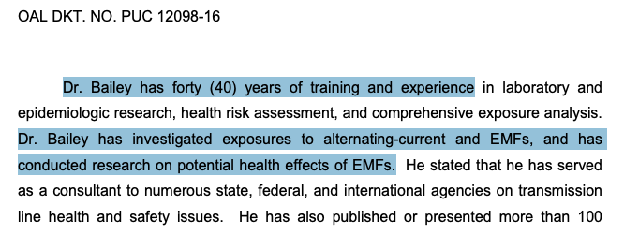
(https://www.nj.gov/bpu/pdf/boardorders/2018/20180620/6-22-18-2M-Initial%20Decision.pdf) From the New Jersey Board of Public Utilities Initial Decision, June 2018: Dr. Bailey is described as having “forty (40) years of training and experience.” As of 2026, that figure is 48 — placing him squarely within Lynch’s “more than 45 years.
Lynch said the scientist used “lab-grade equipment” and found levels 400 times below unsafe zones. That framing — the specific ratio, the specific reference to lab-grade instrumentation — tracks very closely with how Bailey structures his testimony in regulatory proceedings (see below). And the household appliance comparison is not a generic communication strategy. It is Bailey’s move, deployed in the same form, across more than a decade of proceedings.
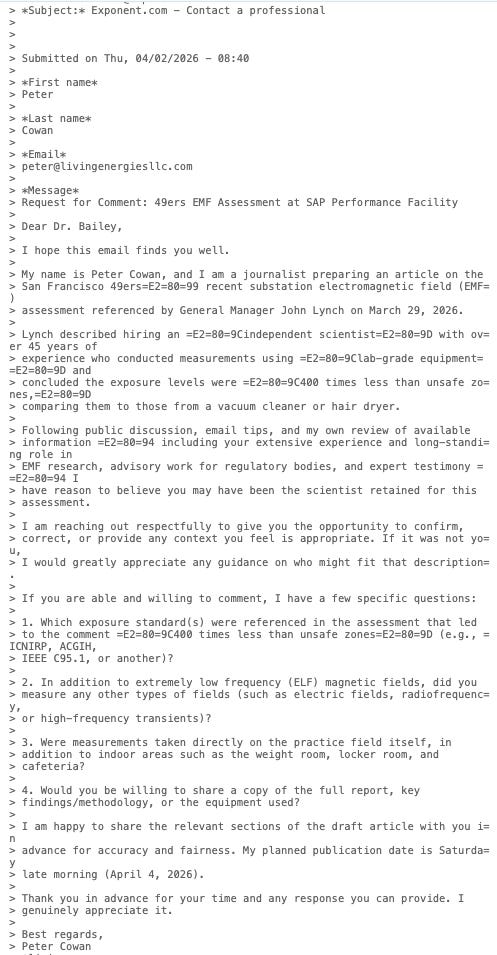
On April 2, 2026, I submitted a detailed request for comment to Dr. Bailey through Exponent’s website, identifying myself as a journalist, describing Lynch’s statements, and stating directly that I had reason to believe he may have been the scientist retained for the assessment — inviting him to confirm, correct, or provide any context he felt appropriate. I also asked four specific methodology questions about the assessment. He responded within the hour:
“Peter, I have no knowledge about the speculations reported in the news reports on this topic. Bill.”
It is worth reading carefully. He does not say he was not retained by the 49ers. He does not say Exponent did not conduct the assessment. He says he has no knowledge of “speculations reported in the news reports” — a formulation that gave him room to maneuver, since my initial email had asked broadly rather than put a binary question directly to him. So I did. In a follow-up sent the same morning, I put two questions to him plainly: Was he the scientist John Lynch was referring to? If not, did Exponent conduct the assessment or write the report? He did not respond.
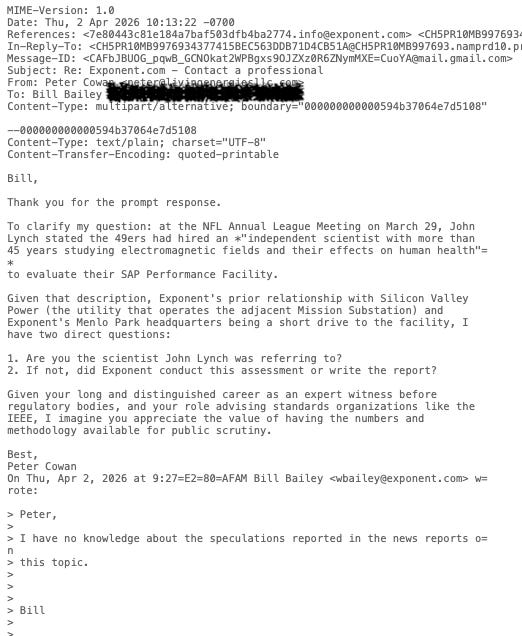
(See the full email exchange in the Appendix)
This investigation was originally structured as two parts: a free section covering the news, and a paid section containing the evidence. I’ve made it all free. The documented record behind this identification — Bailey’s testimony, the conflict of interest, the NFL’s history with independent science — is too important to sit behind a paywall. If you find this work valuable, please consider becoming a paid subscriber.Subscribe
Now on with the evidence.
The Expert Witness
What follows is dense — regulatory proceedings, legal findings, and testimony transcripts across multiple states. Here is the short version: Bailey has spent decades testifying on behalf of utilities that EMF exposure is safe, using the same household appliance comparisons Lynch used, citing standards he himself helps write as co-chair of the IEEE committee responsible for them. When he was finally challenged in court by a credible environmental health scientist, the judge acknowledged the epidemiological evidence of harm was strong — but ruled she had no regulatory framework to act on it, because the only standards available were the ones Bailey’s committee maintained. The system is circular. The section below documents how.
If you trust the summary above, you can skip ahead to “The Industry Behind the Conclusion.” What follows is the evidence.
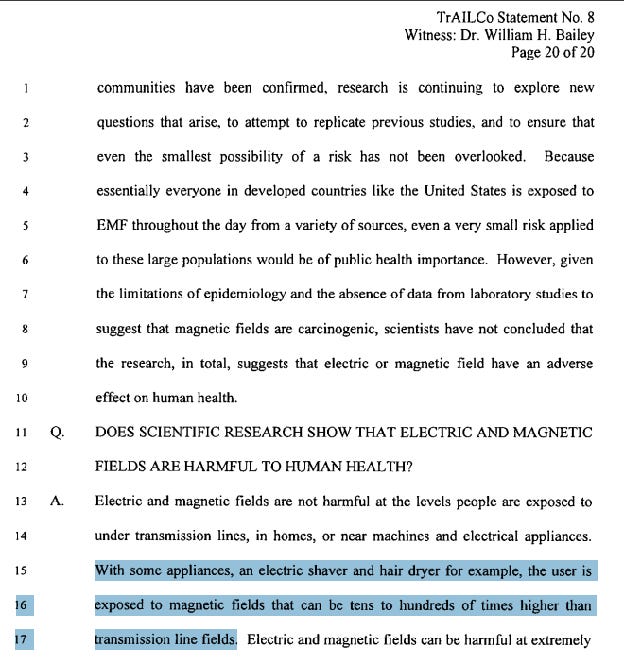
The same “hair dryer” comparison appears in Bailey’s regulatory testimony across four states, in four separate proceedings, across more than a decade:
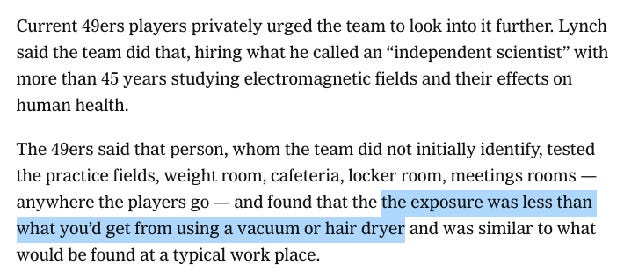
NH SEC 2015-04, Bailey testimony — the proposed 192-mile Northern Pass transmission line through New Hampshire, contested by landowners and environmental groups:
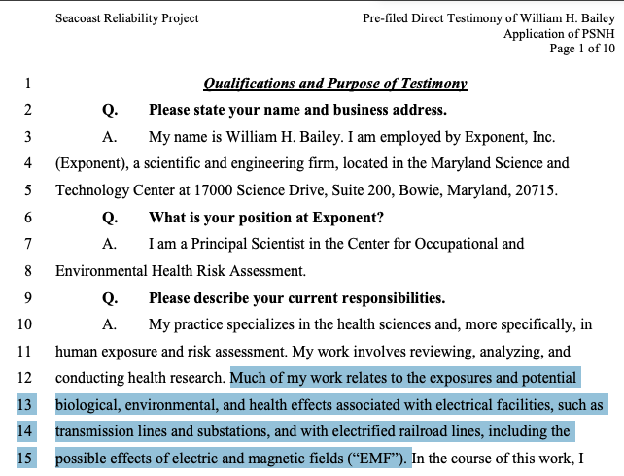
PA PUC A-110172, Bailey testimony — a Pennsylvania utility commission proceeding over a proposed transmission line:
Montgomery County CU 16-04, Bailey testimony — a conditional use hearing before Montgomery County, Maryland for a proposed utility facility:
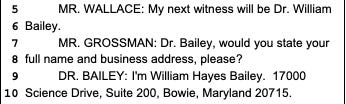
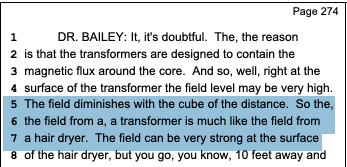
Three states. Three utilities. Three testimonies. Three wins.
Theodora Scarato, who has tracked Bailey’s testimony across utility proceedings for years through her work at Environmental Health Trust and now Environmental Health Sciences, described one instance directly. When a power company proposed a substation across from a Washington DC school — on land being used as a children’s garden — Bailey was retained to testify. “He downplayed the health issue and stated the same thing he has been saying for years — ‘no conclusive evidence” Scarato said. “Even when directly asked if there was data on electrical workers and health risks, he only presented research by electrical company consultants showing no effects, omitting published research going back decades indicating risks. ‘He never presented the recent studies linking exposure to childhood leukemia and instead, gave the inaccurate impression that such associations no longer exist. He also never stated that the WHO’s IARC had classified magnetic fields as a possible carcinogen at all.”
The studies omitted from that testimony include peer-reviewed research finding significantly elevated leukemia risk among electrical workers in New Zealand, and a multi-country study of electric utility workers in Canada and France finding that workers with above-median cumulative magnetic field exposure had more than twice the risk of acute nonlymphoid leukemia.
In another case, in Monmouth County, New Jersey, three township school boards — Middletown, Hazlet, and Holmdel — formally intervened on EMF health grounds. The project was blocked. Before examining that case in detail, it’s worth understanding who Bailey is and what he brings to these proceedings.
In 2001, Bailey sat on the IARC panel in Lyon, France that reviewed all available scientific evidence on extremely low frequency (ELF) magnetic fields and unanimously classified them as Group 2B — a possible cause of cancer in humans. There is no record that he dissented from that unanimous finding. Twelve years later, on Irish national television, he appeared as an invited consultant to EirGrid — a company that develops, manages and operates the power grid in Ireland — and told viewers the scientific evidence does not demonstrate a health risk from EMFs encountered in daily life. EirGrid’s CEO went further, saying it was ‘simply not possible’ for power line EMFs to lead to cancer. Neither mentioned the International Agency for Research on Cancer (IARC) — the WHO body that had unanimously classified ELF magnetic fields as a possible human carcinogen twelve years earlier, a panel Bailey had sat on. The studio audience jeered. EirGrid, the utility he had been flown in from the United States to support, announced days later that it would consider placing the power lines underground.
Bailey’s critics have raised a separate question about his qualifications. His doctorate, earned at the City University of New York in 1975, is in neuropsychology. His dissertation studied avoidance behavior in rats with hereditary hypothalamic diabetes insipidus. He is not an epidemiologist, a medical doctor, or a biophysicist — the disciplines whose findings he regularly critiques in regulatory hearings. Dr. Devra Davis, who identified Bailey by name in The Secret History of the War on Cancer as part of ‘The Truth Machine’, noted that his publication record reflects a career built primarily on systematic reviews, regulatory technical reports, and commentary — papers that analyze other scientists’ data rather than produce new primary research on EMF and health. In cross-examination at the New Hampshire Site Evaluation Committee in 2017, his qualifications to dismiss epidemiological findings were formally challenged on this basis.
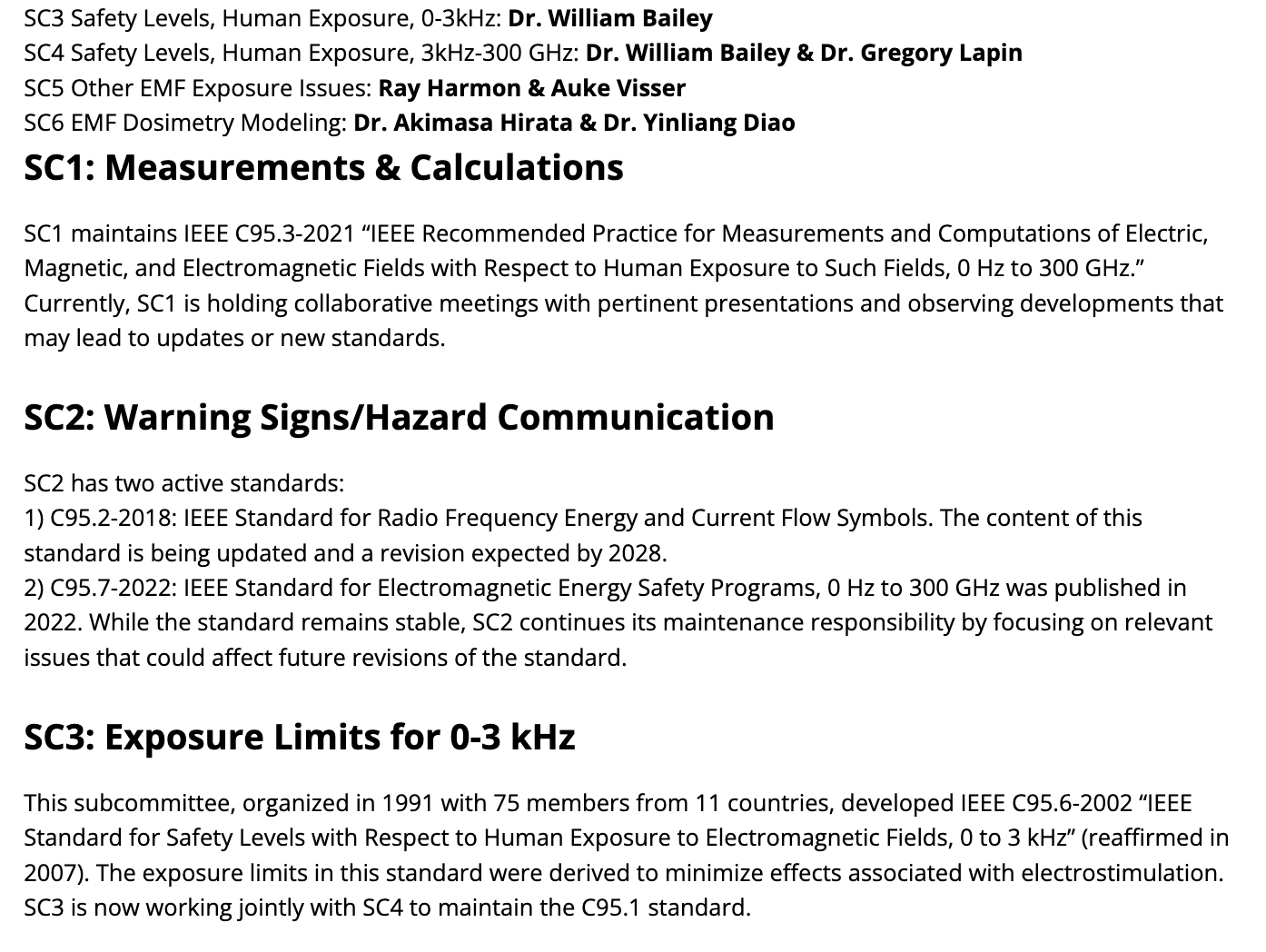
Bailey is currently listed, publicly on the IEEE ICES website, as Chair of Subcommittee 3 (SC3) — Safety Levels, Human Exposure, 0–3 kHz — and as Co-Chair of Subcommittee 4 (SC4), which covers the full 0–300 GHz non-ionizing spectrum. SC3 is the subcommittee whose scope covers 60 Hz power-frequency fields directly; it developed IEEE C95.6-2002 and now works jointly with SC4 to maintain C95.1, the 2019 standard whose occupational limit of 27,100 milligauss at 60 Hz Bailey cites as an expert witness. He is, in other words, the lead author of the standard he applies in the witness chair. Two New Jersey proceedings put that conflict of interest on the record.
In the first, the Oceanview 230 kV project, Bailey testified without opposition. No credentialed counter-witness. No cross-examination on the epidemiology. Even then, the New Jersey Board of Public Utilities (BPU) required post-construction field measurements to verify that estimated exposures matched actual readings. Unopposed, Bailey’s testimony was still not enough to satisfy the regulators that the science was closed.
The second proceeding was different.
In the Monmouth County Reliability Project proceedings before the New Jersey Board of Public Utilities, Jersey Central Power & Light (JCP&L) retained Bailey to support its transmission line application. For the first time in a New Jersey proceeding, he faced a credible public health opponent: Dr. David O. Carpenter, Director of the Institute for Health and the Environment at the University at Albany — a World Health Organization Collaborating Center — and a Harvard-trained physician who has spent decades studying population exposure to environmental toxins. Carpenter argued that EMF exposure above 4 mG causes human disease — a threshold the 49ers facility almost certainly exceeds on any normal training day, and less than half of the 8.5 mG I measured at the fence line. He further argued that the standard setting bodies Bailey relied upon were dominated by physicists and engineers who discounted health evidence. The post-construction field levels modeled by the utility’s own engineers — 39 to 163 mG at the edge of the right-of-way — were, in his words, “outrageously elevated.”
RAGE — Residents Against Giant Electric, the citizen activist group — went further in its formal post-hearing brief to the New Jersey Board of Public Utilities, arguing that Bailey’s rebuttal testimony was “so strident and filled with invective that it plainly demonstrates that he is no impartial and objective expert, but someone whose testimony has for the first time been challenged in New Jersey by a credible public health official.”
The Administrative Law Judge (ALJ) ultimately blocked the project on necessity grounds — finding that JCP&L had failed to demonstrate the line was reasonably necessary given available alternatives. But her findings on the EMF question are worth reading carefully — because the legal language obscures something important. She did not find that the evidence of harm was weak. She found the science to be ‘in equipoise’ — a legal standard, not a scientific one. In her own words, she acknowledged ‘strong epidemiological evidence’ and a ‘consensus… statistically significant association between EMFs and childhood leukemia and adult Alzheimer’s disease.’ She then explained why she couldn’t act on it: ‘state, national and international public health standards’ hadn’t adopted Carpenter’s recommendations, and she had no regulatory framework to apply his conclusions. She could not invent a standard the standards-setting bodies hadn’t adopted.
Read that again. The reason she couldn’t protect the residents of Monmouth County from a risk she acknowledged was epidemiologically supported — is that the standards didn’t allow it. And the standards didn’t allow it in part because the IEEE Co-Chair of the committee, the man who helped write those standards, was sitting across the room in the witness chair arguing they were fine. Bailey’s conflict of interest didn’t just bias the testimony, it also constrained the ruling. RAGE called him partial. The ALJ essentially agreed the epidemiology was strong, but she still couldn’t act on it, because one of the key standards in question is maintained by a committee the same man helps lead — while testifying that the standard is adequate.
(It is worth noting that unlike the DC school proceeding Scarato describes, Bailey did acknowledge IARC’s Group 2B classification in his Monmouth County testimony — the dispute there was not about whether the classification existed, but about what weight it deserved.)
The project was blocked — but not because the ALJ credited Carpenter’s science over Bailey’s. She declined to rule on the EMF health question at all, citing the absence of a regulatory standard she could apply. And Bailey kept testifying.
When Bailey testified before the New Hampshire Site Evaluation Committee in 2017 on behalf of Northern Pass/Eversource Energy, Dr. Denis Henshaw — a retired professor of Human Radiation Effects at the University of Bristol — reviewed the testimony and called him a “professional denialist.” Henshaw’s assessment: “The public is being completely hoodwinked about this, completely hoodwinked.”
Dr. Paul Héroux, Professor of Toxicology and Health Effects of Electromagnetism in McGill University’s Department of Epidemiology, Biostatistics and Occupational Health — the same researcher who told the Washington Post that the EMF-injury hypothesis was “theoretically plausible” — offered a more direct assessment when asked about Bailey specifically:
“Bailey is the expert used by industry to deny health effects of ELF. I have testified against him in the past. You can expect that he will conclude that no effects are possible.”
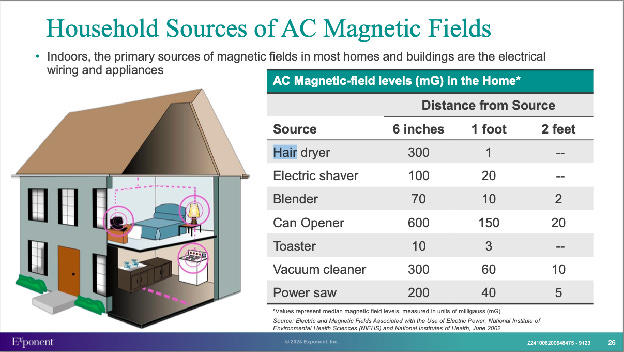
Slide 26 from William H. Bailey, Ph.D., Benjamin Cotts, Ph.D., P.E., and Pamela Dopart, Ph.D., CIH, ‘Assessing Offshore Wind Electromagnetic Fields in Our Communities,’ NYSERDA Offshore Wind Learning from the Experts Webinar Series, October 16, 2024. Source: New York State Energy Research and Development Authority.
In October 2024 — six months before John Lynch stood in a Phoenix conference room and described a facility assessment by an unnamed scientist — Bailey presented to the New York State Energy Research and Development Authority as Exponent’s lead EMF expert. The same household appliance table appeared on slide 26 of the Exponent presentation: hair dryer at 300 mG, vacuum cleaner at 300 mG, sourced from the same 2002 NIEHS publication. The standards slide is equally instructive. In his own public presentations, Bailey cites the IEEE general public limit at 9,040 mG. Four hundred times below that is 22.6 mG — which lands inside my estimated field range for the 49ers facility interior on a normal training day. The number Lynch cited as exculpatory is, on Bailey’s own preferred public standard, a description of the exposure environment.
But the Monmouth County proceedings illuminate a separate question. The post-construction field levels calculated by the utility’s own models ran from 39 to 163 mG at the edge of the right-of-way. The upper end of that range sits above even the most permissive reading of Lynch’s “400 times below unsafe” from the IEEE occupational standard. Bailey argued that level was acceptable in New Jersey. That he may have applied the same framework at the 49ers facility and still called it “a normal gym” raises a question my field estimates can’t fully answer: how high are the actual levels? Carpenter’s lower threshold of concern — 4 mG — sits just below the floor of the 49ers’ exposure range. And 22.6 mG, the number Bailey’s own public standard implies, sits well above it. At the far end — if the IEEE occupational standard was used — the math suggests fields as high as 67 mG. My field estimates may be the floor, not the ceiling.
In plain terms: the numbers from the 49ers facility fall within a range that credible scientists have linked to increased disease risk. The standards used to call those numbers safe were written in part by the same man hired to testify they were safe. The ALJ who reviewed his testimony didn’t dispute the underlying epidemiology. She simply had no other tool to use.
The Industry Behind the Conclusion
As introduced earlier, David Michaels and Devra Davis each independently documented the same system — what Michaels called “product defense” and Davis called “The Truth Machine.” Michaels traced the architecture in Doubt Is Their Product (2008). Davis documented the same playbook across two books: The Secret History of the War on Cancer (2007) named Exponent as one of the central mechanisms for manufacturing doubt, and Disconnect — first published in 2010 and reissued in a new edition as Disconnect: A Scientist’s Solutions for Safer Technology — applied the same analysis to cell phone radiation. Davis called the practitioners “professional doubters.” Michaels called them ”product defense scientists”. They were describing the same people.
Davis — formerly Director of the University of Pittsburgh Cancer Institute’s Center for Environmental Oncology — was one of the first directors of a major cancer research institution to formally raise cell phone safety concerns in 2007. She described how the pattern works from the inside. Her colleagues at the Cancer Institute had assured her that if there were a problem, they would know. She found there was, and made it her job to make it known. She described a recognizable rhetorical move: serious-sounding experts are deployed to create the impression that credentialed people have reviewed the question and found nothing. “We have serious radiologists saying it’s not a problem,” she noted — the implication being that if serious radiologists say so, it must be true. The radiologists, she has found, are rarely as independent as they appear.
The practice works like this: a corporation faces a health-related liability — a toxic chemical, a dangerous product, an environmental exposure — and hires scientists to challenge the evidence of harm. They don’t need to disprove the danger. They need only to create enough uncertainty that regulators, juries, and the public can’t act. The tools are consistent: challenge methodology, demand more research, highlight scientific uncertainty, compare the risk to something familiar and benign.
The tobacco industry pioneered the model in the 1950s, creating a scientific infrastructure to challenge the link between smoking and lung cancer decades after their own internal research had confirmed it. The asbestos industry ran the same playbook. So did lead paint manufacturers, PFAS chemical producers, and pharmaceutical companies defending drugs pulled from the market. Each time: industry-sponsored studies, credentialed expert witnesses, and regulatory delay measured in years or decades. The pattern is documented, consistent, and effective.
Exponent is perhaps the most institutionalized form of this practice. Michaels cited the firm by name more than a dozen times in Doubt Is Their Product. Other product defense firms operate in this space — Gradient, ChemRisk and ENVIRON International have appeared in similar contexts — but Exponent became the largest, the most diversified, and the most frequently retained. If the tobacco era produced the model, Exponent built the model firm.
Exponent
Exponent was founded in 1967 at The Oasis, a beer and burger joint in Menlo Park, by three Stanford professors and two engineers from the Stanford Research Institute. The name Failure Analysis Associates was a joke — one co-founder quipped it was appropriate for a California startup because one-third of Californians were failures and the other two-thirds were in analysis. The formula turned out to be a success. The firm is now publicly traded, with almost $600 million in annual revenues, offices in 20 American cities and five foreign countries, and roughly 1,200 employees — the majority holding advanced degrees in science, engineering, or medicine.
Its revenue depends structurally on companies facing liability. Exponent said so itself. In its 2015 annual report, filed with the SEC under “Risk Factors,” the firm disclosed that if legal or regulatory changes were to “reduce the exposure of manufacturers, owners, service providers and others to liability, the demand for our services may be significantly reduced.” In the world of corporate litigation, “tort reform” refers to laws that limit a person’s ability to file a lawsuit or the amount of money they can recover in damages. Because Exponent’s business model relies heavily on defending corporations against such lawsuits (product liability, environmental claims, etc.), they are legally required to tell investors that if there are fewer lawsuits or less liability for companies, Exponent’s own revenue will suffer. In plainer terms: fewer lawsuits means less business. That is the business model in their own words, in a regulatory filing.
The client list reads like a liability docket. Toyota hired Exponent in 2009 primarily for work challenging sudden, unintended acceleration claims. BP consulted with them after the Deepwater Horizon oil spill. ExxonMobil, and the tobacco industry have both retained the firm, as did the legal teams in the GM ignition switch litigation. Jeffrey Croteau, director of Exponent’s vehicle practice, testified under oath that he had been involved in approximately 500 automotive lawsuits without once concluding that any component of any vehicle was defective. Five hundred cases. Zero defective products.
The client list extends into environmental health as well. When the chromium industry faced pressure from OSHA to lower workplace exposure limits for hexavalent chromium — the same carcinogen at the center of the Erin Brockovich case against PG&E — Exponent produced a reanalysis of a lung cancer mortality study of workers at a Baltimore chromium plant, challenging findings that linked the exposure to cancer. The reanalysis was part of a coordinated industry campaign, documented in a peer-reviewed paper by Michaels himself, to delay a worker protection standard that OSHA had been under court order to issue.
Fiona Mowatt, an Exponent toxicologist, testified in a 2015 asbestos case: “I believe that we aren’t in the business of exonerating the industry; I’m in the business of looking at what the science says.” David Michaels offered a different assessment: “While some might exist, I have yet to see an Exponent study that does not support the conclusion needed by the corporation or trade association that is paying the bill.”
The firm occasionally delivers bad news. In a 2016 interview with FairWarning — a nonprofit investigative journalism outlet — Roger McCarthy, who retired as Exponent’s CEO in 2009, described one such instance: when Exponent investigated a 1996 propane explosion in Puerto Rico that killed 33 people, Enron had hired them hoping the cause would be attributed to natural gas. Exponent concluded it was “absolutely unmistakable” that propane caused the blast. Enron fired them. That story is more damning than if Exponent never delivered bad news at all. It describes a selection effect: the clients who keep calling back are the ones who got what they needed.
Since 2000, Exponent scientists have co-authored roughly 1850 peer-reviewed articles. Some journals request voluntary conflict-of-interest disclosures — when provided, they appear at the end of the full article, behind a $35 paywall. The abstracts are free, but any disclosed conflicts are often not visible there. Five US Senators called on the National Library of Medicine to disclose funding sources in all articles in its free PubMed database. As of this writing, they have not.
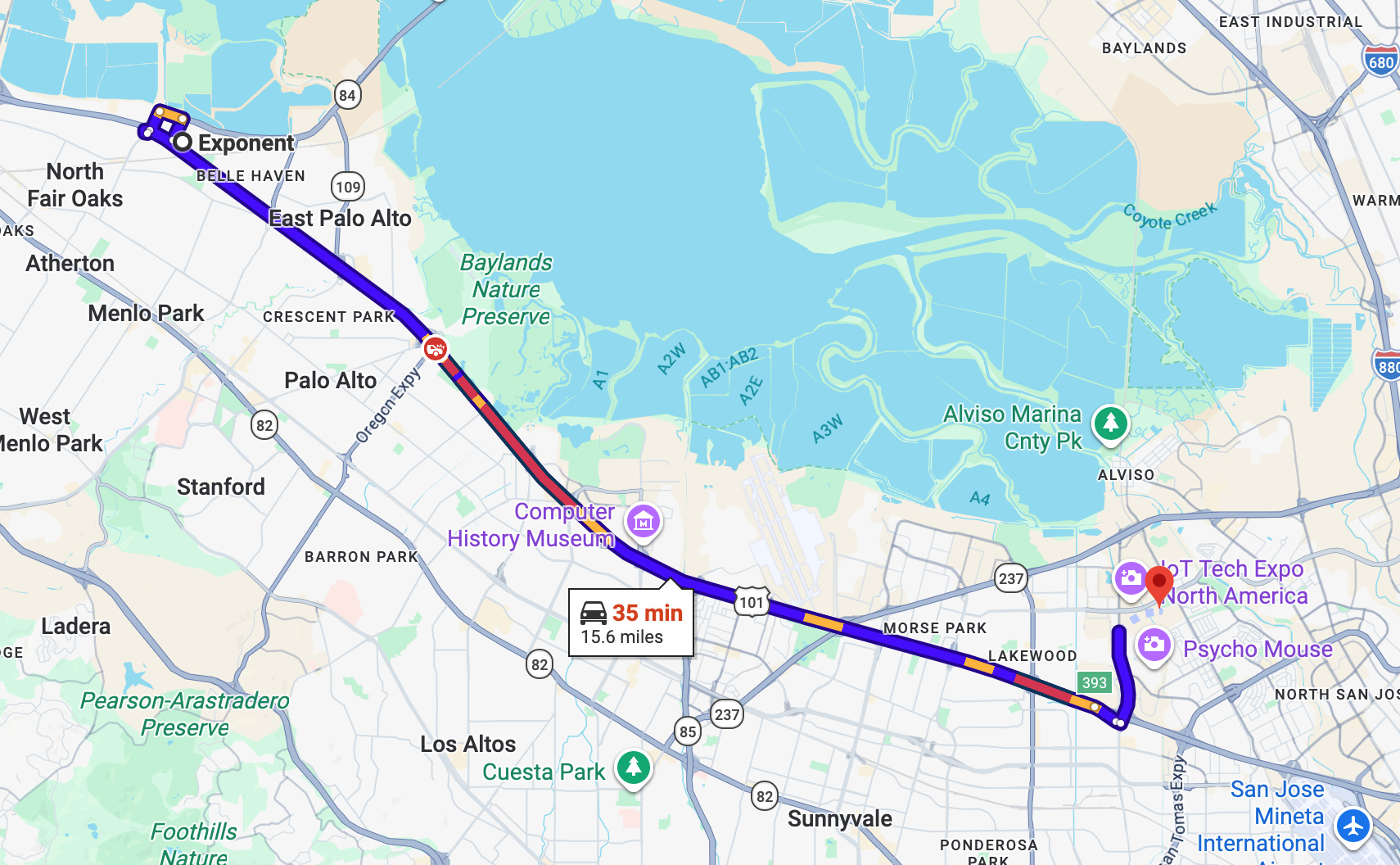
As noted earlier, Exponent’s Menlo Park headquarters sits sixteen miles from the 49ers facility, and the firm had already consulted for Silicon Valley Power — the municipal utility that operates the Mission Substation — when residents raised health concerns about a proposed transmission line in 2024. But the relationship runs deeper than proximity. SVP and the stadium are both municipal assets operating under the same city government — and the expansion wasn’t just about the stadium: Levi’s Stadium runs its own on-site data center and distributed antenna system serving 70,000 fans, and SVP had positioned itself as the power provider for a rapidly expanding cluster of commercial data centers in the surrounding area — part of Santa Clara’s deliberate strategy to become Silicon Valley’s data center hub. The substation needed to be bigger because the grid it feeds was getting bigger. When SVP needed an expert to reassure residents about its expanding capacity, they turned to the same firm that would later be retained to evaluate the 49ers’ facility — Exponent’s EMF practice, working for the same utility, on the same type of question.
Exponent is the firm that perhaps most thoroughly represents this practice, but the 49ers are an NFL franchise, and the NFL has its own history with “independent” science — and its own long record of manufacturing doubt when the science points somewhere inconvenient.
The NFL Has Run This Play Before
As outlined in Part 1, the NFL has a well-documented habit of commissioning “independent” inquiries that turn out to be neither independent nor inquiry. The Deflategate investigation is the clearest example — and Exponent was at its center. In 2015 the league retained outside counsel to investigate Deflategate, who hired Exponent to produce the scientific analysis. Exponent’s 98-page report got Brady suspended and the Patriots fined and stripped of draft picks — before outside researchers proved the pressure drop was fully explained by basic physics.
The NFL was managing concurrent PR pressure at the time: the league’s handling of domestic violence cases involving players like Ray Rice had drawn widespread criticism, and the Patriots had already been penalized for “Spygate” — a scheme in which head coach Bill Belichick directed staff to illegally film opposing coaches’ hand signals. Deflategate offered the league a chance to reassert enforcement authority, with New England as the defendant.
Outside researchers disagreed almost immediately. An MIT professor of mechanical engineering reviewed Exponent’s analysis and concluded there was zero illegal deflation — that the pressure drop was fully explained by the Ideal Gas Law, a physics principle basic enough that it is taught in high school: when temperature falls, gas pressure falls with it. The footballs went from a warm locker room to a cold field, and they behaved exactly as the physics said they would. Cold weather and the timing of measurements accounted for the entire discrepancy.
Separately, the NFL conducted its own air pressure spot checks at halftime of games throughout the 2015 season. NFL general counsel Jeff Pash — the same lawyer who had reviewed and shaped the drafts of the league’s own ‘independent’ Deflategate investigation — ordered those numbers expunged entirely — deleted at his direct order, according to an inside source, and reported by Mike Florio in his book Playmakers. The reason was straightforward: for cold-weather games, the halftime pressure readings were consistent with the Patriots’ footballs from the AFC Championship — evidence of the fundamental laws of physics, not cheating. The league’s public case had been built in part on an early ESPN report that 11 of 12 Patriots footballs were significantly underinflated. Florio later identified the source of that report as NFL executive vice president of football operations Troy Vincent — whether deliberately false or reflecting early confusion, a senior league official had shaped public perception before the facts were established. The data cleared Brady. The league destroyed it.
Deflategate and the substation report are, at their core, disputes about physics — in one, Exponent measured the wrong conditions at the wrong time and ruled the balls had been intentionally deflated; in the other, the independent scientist measured the wrong exposure ceiling — acute when the question was chronic — and ruled the facility safe on that basis. Two situations. Two wrong measurements.
What the league had been managing since 2002 was something else entirely: whether professional football was destroying the brains of the men who played it.
In 2002, forensic pathologist Bennet Omalu performed the autopsy on Mike Webster — Hall of Fame center, dead at 50 after years of cognitive deterioration and escalating pain — and found something in Webster’s brain that had no name yet. A pattern of tau protein deposits, later identified as chronic traumatic encephalopathy, consistent with severe damage from repeated head trauma. When Omalu published his findings in 2005, the NFL’s Mild Traumatic Brain Injury Committee — chaired by Elliot Pellman, a rheumatologist who was the personal physician of NFL commissioner Paul Tagliabue and not a neurologist — demanded the journal retract the paper. Three committee members called his work “completely wrong” and a failure. None were neuropathologists. As Omalu later put it, ‘Some claimed I practiced voodoo not medicine’.
When Ann McKee presented similar findings to the league in 2009, the committee’s co-chair responded by openly mocking her research in front of the room. Another researcher present called the co-chair’s conduct “unprecedented, totally unprofessional, egregious”. The committee had been publishing its own research since 1994 — thirteen papers in Neurosurgery, held up by the league as scientific evidence that brain injuries did not cause long-term harm, but that omitted more than 100 diagnosed concussions. None of the papers acknowledged any link to brain damage. Its legal oversight was assigned to Dorothy Mitchell, a lawyer from Covington & Burling who had previously defended the Tobacco Institute against secondhand smoke lawsuits — and who, before joining the NFL, was one of five lawyers at the firm who had provided legal or lobbying help to both the NFL and the tobacco industry, sometimes in the same year. The NFL acknowledged the link between concussions and CTE in 2016, twenty-two years after forming the committee and fourteen years after Omalu’s discovery.
The pattern extends further. When the NFL leaked Jon Gruden’s private emails — Gruden the former head coach of the Raiders and the Buccaneers — during an unrelated investigation and he sued, the Nevada Supreme Court ruled it “unconscionable” for Commissioner Goodell to arbitrate a dispute where the league was the accused party. This was a rebuke of the near-unlimited authority the NFL holds over players and staff under the collective bargaining agreement (CBA), the labor contract governing every aspect of the league’s relationship with its workforce. The investigation produced no written report — a detail that should now sound familiar.
Brady’s suspension was ultimately upheld not because the science was sound but on procedural grounds — that same CBA authority that every player and staff member at every facility the league controls operates within. That authority exists because, at root, the NFL’s relationship with its players is a labor relationship. The league sets the conditions. The league commissions the science. The league’s workforce — players, coaches, training staff — must work within the conclusions the league produces. The players’ salaries may be large, but their careers are short, and the long-term health consequences arrive after the paychecks stop — a fact that tends to get lost when the public’s sympathy is filtered through the size of the contract.
The pattern the CTE saga established is not just historical context — it is the operating manual. The committee claimed its data was comprehensive while omitting over 100 diagnosed concussions. The 49ers claim their assessment is comprehensive while omitting the methodology, the scientist’s identity, and the full report. Different subject, same epistemic problem: the public is asked to trust a conclusion without access to the underlying data. When outside peer reviewers tried to stop the CTE papers from being published — writing that the committee’s suggestions were “inappropriate and not founded on facts” — the authors dismissed them. Scarato, Carpenter, Henshaw, Héroux — credible scientists raising substantive objections about the 49ers assessment — have been met with silence.
Committee member Dr. Joseph Waeckerle, reflecting on the CTE research years later, put the standard plainly:
“If somebody made a human error or somebody assumed the data was absolutely correct and didn’t question it, well, we screwed up. If we found it wasn’t accurate and still used it, that’s not a screw-up; that’s a lie.” – Dr. Joseph Waeckerle
The 49ers have not released the data. They have not named the scientist. They have not published the report. And they are the only organization with access to the full injury record of every player who has trained in that facility for the last decade. Waeckerle’s framework applies. No journalist has pressed for the methodology. No reporter has demanded they publish the report. We are waiting to find out which category this is — screw-up or lie.
That the same NFL now tells us its practice facility got a clean bill of health from an ‘independent scientist’ — one whose ‘independence’, as we’ve seen, is a matter of interpretation — should, if history has taught us anything, surprise no one.
If Not Bailey
The 49ers have not confirmed the scientist’s identity, but if it isn’t Bailey, the conclusion doesn’t change. The ecosystem that produces these reports is small, and the alternatives are drawn from the same network.
One possible alternative candidate is Dr. Jerrold T. Bushberg, Professor Emeritus of Radiology and Radiation Oncology at UC Davis School of Medicine and Chairman of the Board of Directors of the National Council on Radiation Protection and Measurements — one of the most influential standards bodies in the field. His PhD from Purdue’s Department of Bionucleonics dates to 1983, but his professional analysis of radiofrequency systems dates to 1978 — putting him at more than 45 years in the field as of 2026, consistent with Lynch’s ‘more than 45 years.’ He is based in Sacramento, making him local to Santa Clara. He has consulted for the City of San Francisco and various California school districts on EMF safety questions. He has also served for decades as a paid consultant and expert witness for wireless carriers. He carries lab-grade equipment. Like Bailey, he helps write the standards he applies as a consultant — the same structural conflict this article has documented throughout.
According to a January 2026 filing by Environmental Health Sciences before the Federal Communications Commission, Bushberg has served for decades as a paid consultant and expert witness for wireless companies including Crown Castle, AT&T, Verizon, T-Mobile, Sprint, and CTIA. Public records document his appearances on behalf of applicants seeking cell tower approvals across multiple states, and at least one trade publication identified him as a frequent consultant to the cellular industry as early as 2000. The filing notes he also appeared in promotional materials for Cellular One and lobbied on behalf of Pacific Telesis Group.
What separates him from Bailey is the specific testimony signature. Bushberg’s expertise runs heavily toward ionizing radiation and radiofrequency fields. The vacuum cleaner and hair dryer comparison is the rhetorical fingerprint of the power-frequency ELF community — the substation specialists — not the radio frequency world Bushberg primarily inhabits. There is also an institutional consideration: the NFL does not typically hire individual professors for high-liability independent inquiries. They hire firms. Exponent provides not just a scientist but also legal and logistical apparatus — liability coverage, document management, established protocols. For the 49ers to retain an individual academic rather than a firm would be a departure from the institutional pattern the league has established.
One source with direct knowledge of the EMF product defense landscape — a researcher who has faced industry expert witnesses in legal proceedings for decades — asked not to be identified. Their assessment: “If it is not Bailey, then I would guess it is Jerrold Bushberg, another industry consultant masquerading as a public health expert.” The significance is not the guess itself but who is making it: someone who knows both men’s work, their roles in the ecosystem, and the narrow field of candidates capable of producing this kind of assessment.
Other names appear in the product defense literature — Dr. Peter Valberg of Gradient, a physicist and former Harvard professor now in emeritus status whose career spans more than 55 years, would almost certainly be described as having “over 50 years” rather than Lynch’s specific “more than 45”; Dr. Asher Sheppard, a California-based EPRI contractor, has no publicly documented professional activity since 2015, aside from attending an IEEE TC95 meeting January 2023. The field of active candidates with the tenure, the tools, the institutional backing, and the specific household appliance framing to satisfy a client the size of the 49ers has narrowed considerably. It points in one direction.
None of this is a personal indictment of William Bailey, Jerrold Bushberg or any of the other scientists in this field. Bailey has spent nearly fifty years building genuine expertise in a technically demanding field — and within the regulatory paradigm that currently exists, he has done that job exceptionally well. Most people are not moral crusaders or whistle-blowers. They find a niche, develop real competence, and build a career. Bailey found his at the intersection of EMF science and regulatory testimony, and he is very good at it. The problem is not the individuals. The problem is the system — one in which the incentives are so thoroughly aligned that no individual bad actor is required.
When it comes to EMF: EPRI funds the research, ICNIRP sets the limits, and IEEE ICES writes the standards. Each organization would describe its role as advisory — providing guidance that regulators may choose to adopt. In practice, no major US regulatory body has established independent EMF limits; the standards these groups produce are what gets applied in every proceeding, at every utility hearing, and, apparently, in every facility assessment. If it wasn’t William Bailey, it would be someone else.
Dr. Bushberg, Dr. Valberg, and Mr. Sheppard were each contacted for comment prior to publication. None responded.
An Incomplete Response Is Still a Response
There is a useful precedent for how a mainstream institution handles elevated magnetic fields at a workplace — and Sam Milham, an epidemiologist who spent decades with the Washington State Department of Health studying occupational disease, found himself at the center of one such case. In the mid-2000s, Milham was contacted by teachers at La Quinta Middle School in the Coachella Valley, southeast of Palm Springs, who believed they were experiencing an unusual number of cancer cases among their colleagues.
Milham documented what he concluded was a cancer cluster at La Quinta Middle School, tracing it to high-frequency voltage transients — dirty electricity — riding on the school’s wiring, generated in part by a cell tower on the roof. Measurements also revealed elevated AC magnetic fields in the 20 to 30 milligauss range throughout the facility. The school district disputed both the cluster and his methodology. Their response to the elevated magnetic field readings was to shield one room in the 20 to 30 milligauss range — the same field range estimated for the 49ers facility — while declining to test for dirty electricity. When Milham sought to continue his investigation, the district declined further access. But they did shield one documented exposure.
The dirty electricity question almost certainly wasn’t in the 49ers report, but a stadium complex adjacent to an active electrical substation — with variable frequency drives running HVAC systems generating harmonics (electrical noise at multiples of the standard 60 Hz frequency, created by electronic equipment and fed back onto the power grid) by design, distributed antenna systems pushing switching loads through hundreds of small-cell nodes, and dark fiber IT infrastructure feeding harmonic distortion back onto the local grid — almost certainly has elevated dirty electricity.
That’s a separate article, coming soon. The point here is narrower: La Quinta shielded for a magnetic field exposure in the same range the 49ers facility likely produces. Even that response — incomplete, reluctant, eventually hostile — acknowledged the environment as a factor. The 49ers did not.
The 49ers hired a firm to produce a scientific conclusion. The firm produced it. Critics of product defense science would say the question wasn’t investigated — it was processed. That’s not a conspiracy, but it is a highly profitable business model, documented across five decades and dozens of industries, refined to the point where the conclusion tends to be fixed before a single reading is taken.
The science was never the point. The point was a quote, a ratio, and a headline: 400 times below unsafe. A number that they believed would move through the news cycle on a Sunday when the sports media was watching basketball, and then stop being a story.
Susan D. Foster is a writer and researcher who organized a landmark 2004 brain scan study of firefighters exposed to an RF cell tower. Using SPECT imaging — a technique that maps brain activity by measuring blood flow — she found significant brain damage in firefighters where an industry expert had declared the emissions safe. When contacted for comment, she offered this:
“Corporations rarely make products safer unless it has become cost-effective for them to do so. In practice, change often comes only after litigation becomes expensive or exposes internal documents showing corporate officers were aware of safety concerns and failed to act. In those situations, companies are not usually driven by compassion for the people who were hurt, but by the risk that proof of concealed safety problems could lead to significant liability.”
For more on Foster’s firefighter research and the SPECT findings: https://ehtrust.org/a-cautionary-tale-from-firefighters-of-california-fighting-cell-towers-on-stations/
The NFL is not a chemical company, but as we saw with the CTE saga, harm comes in many forms, but the logic stays the same.
Dr. Devra Davis, who has spent decades studying the gap between what science shows and what regulators require, framed the broader problem:
“What needs to change is how we approach toxic hazards. Instead of assuming they are innocent until proven guilty, newly introduced materials in commerce should be required to show evidence of safety. The current standard of proof is sick or dead bodies — mounted in sufficient numbers to achieve statistical significance.”
On the specific question of EMF research, she was equally direct:
“If we fail to pay attention to the findings of animal research, we are condemning people to be lab rats in an experiment with no controls. By the time you can prove harm, we’ve already lost one or two generations. We know enough now to act. We need to reduce EMF radiation in the environment.”
On what a credible review of the 49ers facility would require, she was equally unsparing:
“If the 49ers wanted an open and honest review, it would not be one unnamed scientist. It would be a public review — what they measured, how they measured it, what they reviewed. Those are important questions, and they have not been answered. Certainly not by an ‘independent scientist’ who is not named. Many of them turn out to be hired guns.”
“Those are important questions, and they have not been answered. Certainly not by an ‘independent scientist’ who is not named. Many of them turn out to be hired guns.” – Dr. Devra Davis, epidemiologist, toxicologist, member of the Nobel Peace Prize-winning IPCC scientific team
Dr. Héroux raised a separate point that deserves inclusion here. Elite athletic training is built on deliberate micro-trauma — muscles, tendons, and ligaments are intentionally stressed past their current capacity so that repair mechanisms rebuild them stronger. That is not a side effect of training, it is the mechanism of training. The biological pathways that EMF disrupts — the same oxidative stress cascades and collagen synthesis pathways this series has documented across multiple installments — are the same pathways that an NFL athlete depends on most, and at a scale of biological demand that general populations never approach.
The epidemiological thresholds that form the basis of every public health limit in this space were derived from studying general populations — sedentary or lightly active people going about ordinary lives. Applying those thresholds to men absorbing full-speed collisions and running at maximum output for hours a day is a category error stacked on top of the category error already documented here. As Héroux put it directly: “Do not assess the vulnerability of 49er athletes to magnetic field exposures based on environmental health metrics that are appropriate for their fans.” A credible review of the 49ers facility would not just measure the fields. It would ask what those fields mean for a body that is deliberately operating at the outer edge of its repair capacity every single day.
In La Quinta, the school district responded by shielding the room with the elevated magnetic field and called it resolved. An incomplete solution — but one that at least acknowledged the environmental factor. The 49ers announced $9 million in hydrotherapy equipment and physical therapists, going out of their way not to acknowledge the problem, treating the issue as one of dissatisfied players who needed better care. The electromagnetic question wasn’t so much closed as it was completely discarded.
They upgraded the massage tables, signed Dre Greenlaw to a one-year deal — a linebacker returning from his second major connective tissue injury in two years — and crossed their fingers, following, to the letter, the same script the league has used before.
Updated April 11, 2026 to include additional commentary from Dr. Paul Héroux and an expanded analysis of the hair dryer comparison.
Appendix
Initial email to Dr. William Bailey:
References
The Announcement
- John Lynch press conference (full video), NFL Annual League Meeting, March 29, 2026:
- John Lynch press conference, NFL Annual League Meeting, Phoenix, AZ, March 29, 2026: https://sfstandard.com/2026/03/29/john-lynch-sf-49ers-trent-williams/
- 49ers 2026 free agency tracker: https://www.espn.com/nfl/story/_/id/48083531/san-francisco-49ers-2026-free-agency-tracker-offseason-moves-signings-contract-trades
- 2026 NCAA Tournament Elite Eight schedule: CBS Sports / NCAA.com, March 29, 2026
- Mundo Deportivo, January 22, 2026: https://www.mundodeportivo.com/nfl/20260122/1002606184/49ers-investigaran-entrenar-subestacion-electrica-influyo-lesiones.html
- AS.com, January 2026: https://en.as.com/nfl/what-is-the-49ers-viral-substation-theory-and-could-it-actually-be-causing-more-injuries-f202601-n/
- Daily Mail, 2026: https://www.dailymail.co.uk/sport/nfl/article-15689583/san-francisco-49ers-power-station-conspiracy.html
The Number
- ICNIRP 1998 occupational limit (4,170 mG): Health Physics 74:494–522, 1998
- ICNIRP 2010 (10,000 mG): Health Physics 99:818–836, 2010; PMC5923684
- IEEE C95.1-2019 occupational limit (27,100 mG at 60 Hz): IEEE Xplore DOI: 10.1109/IEEESTD.2019.8859679 — confirmed from primary document, p.103
- Peter Cowan’s gaussmeter reading, December 1, 2025 — personal measurement
Even the Most Charitable Reading Doesn’t Clear
- General public ceiling 2,000 mG: ICNIRP 1998 (above)
- IARC Group 2B classification, ELF magnetic fields, 3–4 mG threshold: IARC Monographs Vol. 80, 2002: https://monographs.iarc.fr/ENG/Monographs/vol80/
- California DHS EMF Risk Evaluation: Neutra, DelPizzo, Lee, 2002: https://emfsafetynetwork.org/wp-content/uploads/2009/10/CDHS_ExecSumm.pdf
- Scarato T, “Escalating Non-Ionizing Electromagnetic Fields from Telecommunications and Electricity.” In The Impact of Anthropogenic Activities on the Natural Environment and Societies during the Contemporary Period, CRC Press, 2026
- Environmental Health Sciences, global EMF policies summary: https://ehsciences.org/powerlines-emf-elf-magnetic-fields-health/#UEEMF-Global-Policies-To-Min-Exposure
The Company Behind the Conclusion
- David Michaels, Doubt Is Their Product, Oxford University Press, 2008
- Tobacco industry “doubt” memo: Brown & Williamson document: https://exposetobacco.org/news/tobacco-industry-lies/
- Devra Davis, The Secret History of the War on Cancer, Basic Books, 2007
- Devra Davis, Disconnect: A Scientist’s Solutions for Safer Technology, new edition, 2024
- Michaels on Exponent, Gradient, ChemRisk, ENVIRON: https://www.fastcompany.com/1139299/manufacturing-doubt-product-defense
- Center for Public Integrity, “Meet the Rented White Coats”: https://publicintegrity.org/environment/meet-the-rented-white-coats-who-defend-toxic-chemicals/
- ChemRisk and ENVIRON alongside Exponent in chromium case: https://www.thepumphandle.org/2006/12/07/a-chrome-plated-controversy/
- Exponent founding history, client list, business model: Levin M, Feldman P. Capitol Weekly, December 2016: https://capitolweekly.net/science-companies-legal-exponent/
- Exponent revenue and financial results, fiscal year 2025: https://investors.exponent.com/investors/news-events/news-details/2026/Exponent-Reports-Fourth-Quarter-and-Fiscal-Year-2025-Financial-Results/default.aspx
- Exponent employee count: https://stockanalysis.com/stocks/expo/employees/
- Toyota/Exponent relationship: https://pressroom.toyota.com/toyota-update-our-work-with-exponent/
- BP/Exponent relationship, Deepwater Horizon: https://www.ftm.eu/articles/bp-research-liability-deepwater-horizon-oil-spill
- Hexavalent chromium / OSHA standard campaign: Michaels D, Monforton C, Lurie P. “Selected science: an industry campaign to undermine an OSHA hexavalent chromium standard.” Environmental Health, 2006; 5:5: https://link.springer.com/article/10.1186/1476-069X-5-5
- Menlo Park HQ: https://www.exponent.com/offices/menlo-park
- Santa Clara Stadium Authority: https://www.santaclaraca.gov/our-city/santa-clara-stadium-authority
- PowerPros, Mission Substation project completion (~May 2014): https://powerpros.net/portfolio/city-of-santa-clara-silicon-valley-power-mission-substation-project/
- City of Santa Clara business directory, Silicon Valley Power: https://www.santaclaraca.gov/Home/Components/BusinessDirectory/BusinessDirectory/515/3650?alpha=S
- Dr. Gabor Mezei biography, Exponent: https://www.exponent.com/people/gabor-mezei
- Silicon Valley Voice, SVP transmission line / Mezei consultation: https://www.svvoice.com/new-transmission-line-will-fuel-svp-growth/
- ServeTheHome, Levi’s Stadium Intel data center: https://www.servethehome.com/inside-the-secret-data-center-at-the-heart-of-the-san-francisco-49ers-levis-stadium-intel/
The Expert Witness — Dr. William Bailey
- Bailey biography, CV, dissertation: Exponent website: https://www.exponent.com/professionals/b/bailey-william-h/; NY DPS prefiled testimony Exhibit (FIP-1): https://documents.dps.ny.gov/public/Common/ViewDoc.aspx?DocRefId={FF430571-E101-4414-B552-6CDE50656FF8}
- SC4 Co-Chair, IEEE ICES Administrative Committee: https://sagroups.ieee.org/ices/adcom/
- IEEE ICES Subcommittee structure (SC3/SC4): https://sagroups.ieee.org/ices/tc95/
- NH SEC 2015-04 testimony: https://www.nhsec.nh.gov/projects/2015-04/application/2015-04_2016-04-12_pdtestimony_w_bailey.pdf
- PA PUC A-110172 testimony: https://www.puc.pa.gov (search docket A-110172)
- Montgomery County CU 16-04 testimony: https://www.montgomerycountymd.gov/OZAH/Resources/Files/pdf/2016/CU%2016-04%20Transcript%201-7-16%20Hearing.pdf
- NJ BPU Monmouth County (school boards): https://www.nj.gov/bpu/pdf/boardorders/2018/20180620/6-22-18-2M-Initial%20Decision.pdf
- IARC 2001 panel membership: IARC Monographs Vol. 80, List of Participants, p.3 — W.H. Bailey, Exponent, confirmed member
- EirGrid RTÉ appearance: Microwave News, 2013: https://microwavenews.com/short-takes-archive/2013
- Henshaw “professional denialist”: https://www.forestsociety.org/news-article/nh-getting-hoodwinked-health-and-safety-northern-pass
- NH SEC cross-examination on qualifications, August 31, 2017: https://www.nhsec.nh.gov/projects/2015-06/transcripts/2015-06_2017-08-31_transcript_afternoon.pdf (pages 60–75)
- Devra Davis, The Secret History of the War on Cancer, Chapter 10 (above)
- Bailey WH, Cotts B, Dopart P. NYSERDA Offshore Wind Learning from the Experts Webinar Series, October 16, 2024: https://www.nyserda.ny.gov/-/media/Project/Nyserda/Files/Programs/Offshore-Wind/NYSERDA-webinar-101624-Assessing-OSW-EMF-Exponent.pdf
- Scarato T, personal communication, contacted for comment prior to publication
- Carpenter DO. “Extremely low frequency electromagnetic fields and cancer: How source of funding affects results.” Environmental Research, 2019
- New Zealand case-control study, acute leukemia in electrical workers: https://pubmed.ncbi.nlm.nih.gov/11562108/
- Ontario/Quebec/France utility workers cancer study: https://academic.oup.com/aje/article-abstract/145/6/567/157749
- EHN, Alzheimer’s and power line EMF: https://www.ehn.org/alzheimers-power-line-emf-radiation
- EHN, power line EMF and childhood cancer: https://www.ehn.org/power-line-emf-childhood-cancer
The NFL Has Run This Play Before — Deflategate
- MIT professor John Leonard analysis: Sports Illustrated, October 4, 2016: https://www.si.com/nfl/2016/10/04/tom-brady-deflategate-ideal-gas-law
- NFL data expunged, Jeff Pash order: https://www.nbcsportsboston.com/nfl/new-england-patriots/report-nfl-covered-up-key-deflategate-evidence-that-favored-pats/201858/
- Ted Wells / Paul Weiss independence criticism: https://www.nbcsports.com/nfl/profootballtalk/rumor-mill/news/ted-wells-independent-investigator-in-name-only
- Brady suspended: https://bleacherreport.com/articles/2338138-tom-brady-suspended-patriots-fined-lose-2-draft-picks-for-deflategate
The NFL Has Run This Play Before — CTE / Omalu
- PBS Frontline, League of Denial: https://www.pbs.org/wgbh/frontline/documentary/league-of-denial/
- Union of Concerned Scientists, NFL intimidation of researchers: https://www.ucs.org/resources/nfl-tried-intimidate-scientists-studying-link-between-pro-football-and-traumatic-brain
- Bennet Omalu, Wikipedia: https://en.wikipedia.org/wiki/Bennet_Omalu
- Elliot Pellman credentials and MTBI Committee: https://www.espn.com/espn/otl/story/_/id/9561661/central-figure-nfl-concussion-crisis-appointed-years-ago-league-position-commissioner-paul-tagliabue-patient
- NFL tobacco connection, Dorothy Mitchell: https://www.boston.com/sports/sports-news/2016/03/24/nfl-deeply-flawed-concussion-research-ties-big-tobacco/
- MTBI Committee data manipulation: https://www.cbsnews.com/newyork/news/nfl-committee-concussion-research/
- NFL admits CTE link, 2016: https://www.forbes.com/sites/nicolefisher/2016/03/14/nfl-forced-to-admit-in-congressional-roundtable-connection-between-football-and-brain-degeneration/
- Waeckerle JF, quoted in: New York Times, March 24, 2016: https://www.nytimes.com/2016/03/25/sports/football/nfl-concussion-research-tobacco.html
- Omalu’s original 2005 Neurosurgery paper: Omalu BI, DeKosky ST, Minster RL, et al. Neurosurgery 2005;57(1):128–134
- Retraction demand — PBS Frontline transcript: https://www.pbs.org/wgbh/frontline/documentary/league-of-denial/transcript/
- “Voodoo” quote — Omalu’s own account: Omalu, Bennet. Truth Doesn’t Have a Side: My Alarming Discovery about the Danger ofContact Sports (Zondervan, 2017). Sample excerpt: https://d3iqwsql9z4qvn.cloudfront.net/wp-content/uploads/sites/2/2018/12/11210338/TruthSide2_samptxt.pdf
- NFL/tobacco connection, Mitchell and Covington & Burling: New York Times via Boston.com, March 24, 2016: https://www.boston.com/sports/sports-news/2016/03/24/nfl-deeply-flawed-concussion-research-ties-big-tobacco/
- Mike Webster Obituary – https://www.legacy.com/obituaries/name/mike-webster-obituary?pid=506288
The NFL Has Run This Play Before — Washington / Concussion Settlement / Courts
- House Oversight Committee, Washington investigation: https://oversightdemocrats.house.gov/news/press-releases/oversight-committee-releases-new-documents-raising-questions-about-nfl-s
- UCSF, race-norming denial rates: https://www.ucsf.edu/news/2020/12/419426/race-norming-blamed-denying-payouts-ex-nfl-players-dementia
- Brian Flores court ruling, ESPN: https://www.espn.com/nfl/story/_/id/45973801/court-agrees-brian-flores-suit-vs-nfl-3-teams-go-trial
- Jon Gruden court ruling, Nevada Supreme Court: https://www.reviewjournal.com/sports/nfl/court-rules-former-raiders-coach-cant-be-forced-into-arbitration-with-nfl-3415938/ https://www.nytimes.com/athletic/6547625/2025/08/11/jon-gruden-nfl-nevada-supreme-court/
If Not Bailey
- Peter Valberg emeritus status / Gradient team page: https://www.gradientcorp.com/staff
- Bushberg official bio: https://www.arrl.org/jerry-bushberg-ph-d
- Bushberg CTIA / Pacific Telesis consulting: https://www.rcrwireless.com/20000731/carriers/health-related-lawsuits-on-front-burner
- Scarato T, Environmental Health Sciences. Reply Comments in WT Docket No. 25-276, FCC, January 15, 2026. Attachment 1: Documentation of Jerrold Bushberg wireless industry consultation: https://www.fcc.gov/ecfs/document/10116252482794/1
- Asher Sheppard last documented professional activity, 2015: https://www.sandiegocounty.gov/content/dam/sdc/pds/ceqa/Soitec-Documents/Record-Documents/2015-02-03-AsherShepard-Memo-to-Dudek-Re-Responses-to-EMF-Comments.pdf
- Sheppard IEEE TC95 participation: https://wireamerica.org/ieee/tc95/
An Incomplete Response Is Still a Response
- Milham S, Morgan LL, “A new electromagnetic exposure metric: High frequency voltage transients associated with increased cancer incidence in teachers in a California school,” Am J Ind Med. 2008;51(8):579-586
- La Quinta cancer cluster investigation: https://kesq.com/news/2015/02/12/in-depth-investigation-examining-reports-of-a-cancer-cluster-at-la-quinta-middle-school/
Closing
- Foster SD. Firefighter SPECT brain scan study, 2004. Documented at Environmental Health Trust: https://ehtrust.org/a-cautionary-tale-from-firefighters-of-california-fighting-cell-towers-on-stations/
Subscribe to Peter Anthony Cowan – Living Energy
By Peter Cowan · Launched 5 months ago
Exploring how light & electromagnetic environments shape mitochondrial & metabolic health, connecting biology to cultural phenomena, health trends, and larger forces through clinical practice.Subscribe
By subscribing, you agree Substack’s Terms of Use, and acknowledge its Information Collection Notice and Privacy Policy.
Discussion about this post
Above 500nT is RED: https://www.baubiologie.de/downloads/SBM-2024-RICHTWERTE.pdf
Its bad!
Wow, you left no stone unturned. Looking forward to the repercussions. In a better world the ’49ers would be eager to fix the players’ outsize injury rate, while in this world the response is “nothing needs fixing, business as usual”.
Jan 5
186
84
35
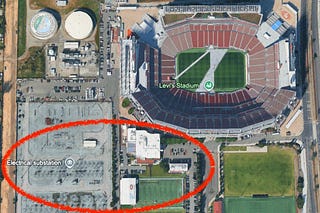
Jan 7•Peter Cowan
74
14
13
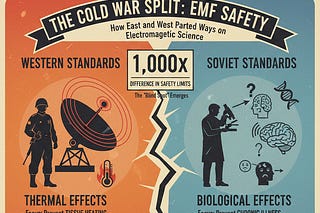
Jan 9•Peter Cowan
18
6
2