Kari Bundy – Health Activist comments on Facebook
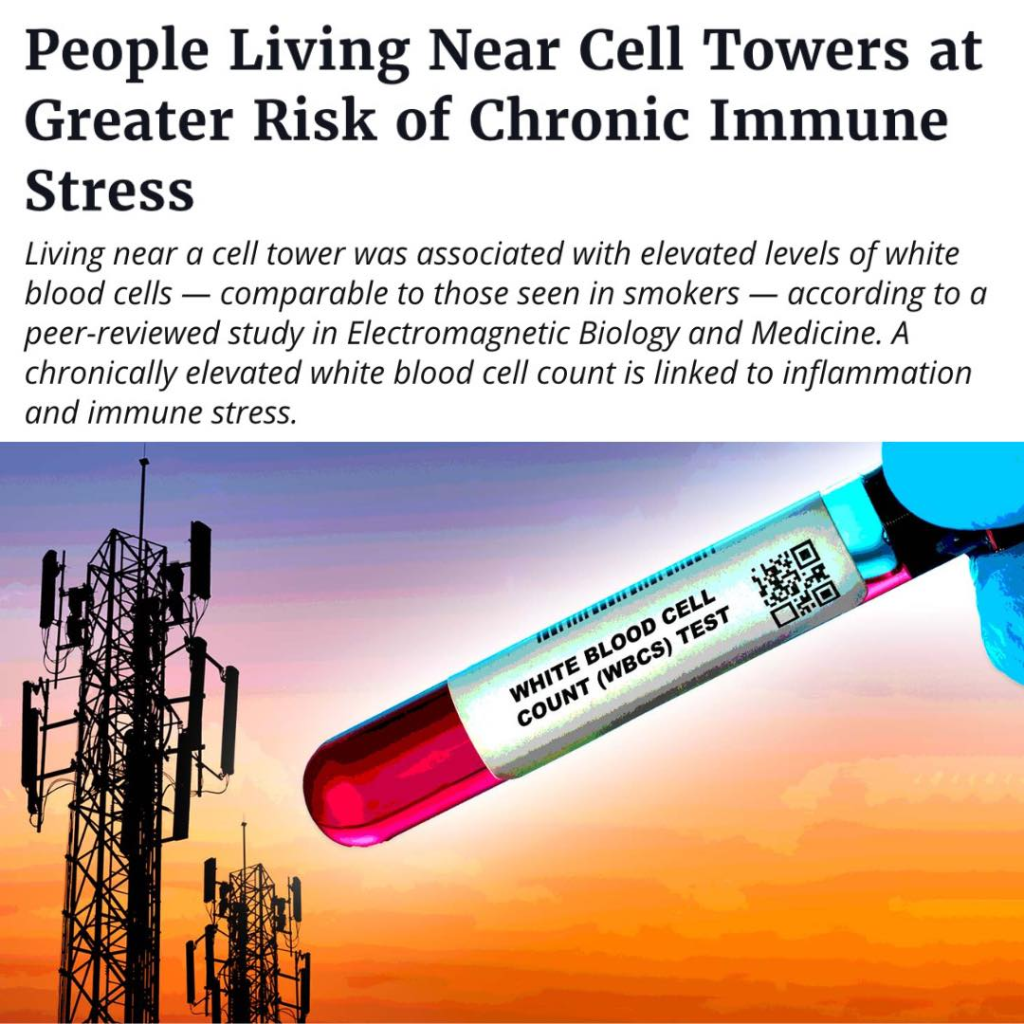
 A concerning new peer-reviewed study published in Electromagnetic Biology and Medicine reveals compelling evidence that chronic exposure to radiofrequency (RF) radiation from nearby cell towers and heavy cellphone use may place significant stress on the human immune system.
Conducted in Aizawl, India, the research examined 101 adults: 50 living within 60 meters of a cell tower and 51 residing more than 300 meters away.
Participants were carefully matched for age and gender, with RF levels measured in their homes and confounding factors like occupational exposure minimized.
The blood analysis yielded striking results:
• Nearly 24% of those living close to cell towers exhibited elevated monocyte levels—a key indicator of systemic inflammation—comparable to patterns observed in chronic smokers. Monocytes play a central role in driving inflammation and are linked to heightened cardiovascular risks.
• Among heavy cellphone users (4–6 hours daily), over 50% showed abnormally high lymphocyte counts, with the effect most pronounced in adults under 30.
While stress biomarkers such as cortisol and amylase showed inconsistent patterns, the overall profile points to a biological stress response: RF radiation appears to trigger chronic immune activation, potentially leading to depletion over time.
Study co-authors Julie McCredden, Ph.D., and Zothan Siama, Ph.D., state: “People’s everyday exposures to mobile phones and towers may be affecting their health by creating or adding to inflammatory conditions and immune system depletion.”
They further note that “cell tower exposure may be contributing to the range of chronic inflammatory conditions we are seeing in the modern world,” describing these as physical stressors often overlooked in conventional medical training.
Epidemiologist Nicolas Hulscher highlighted the monocyte finding as particularly alarming, emphasizing monocytes’ role in systemic inflammation and vascular injury.
This builds on the authors’ prior 2025 work in the same region, which linked closer proximity to towers with increased reports of allergies, infections, and cognitive complaints.
Together, the evidence suggests cumulative RF exposure could contribute to broader health challenges, including inflammatory diseases, cardiovascular issues, diabetes, and potentially elevated cancer risk—effects documented in prior global research at exposure levels far below current U.S. FCC guidelines, unchanged since 1996.
Notably, India’s RF limits are already 10 times stricter than those in the United States (e.g., 45 vs. 450 microwatts/cm² at 900 MHz), yet measurable immune alterations still appeared.
These findings demand urgent attention.
With wireless infrastructure expanding rapidly—often near homes, schools, and workplaces—outdated exposure standards no longer suffice to protect public health, particularly for vulnerable populations like children.
Are we adequately safeguarding our immune health in an increasingly wireless world?
This study suggests the answer is no, and the consequences could be profound.
What are your thoughts?




You’ll find other posts on this blog related to cell phones and towers at these links: https://neighborsorganizingagainsttrespassingtechnology.blog/category/cell-phones/
https://neighborsorganizingagainsttrespassingtechnology.blog/category/cell-towers/
 Neighbors Organizing Against Trespassing Technology
One thought on “A concerning new peer-reviewed study published in Electromagnetic Biology and Medicine re Towers & Phones”