Original Source Link: https://pubmed.ncbi.nlm.nih.gov/35114921/
Abstract
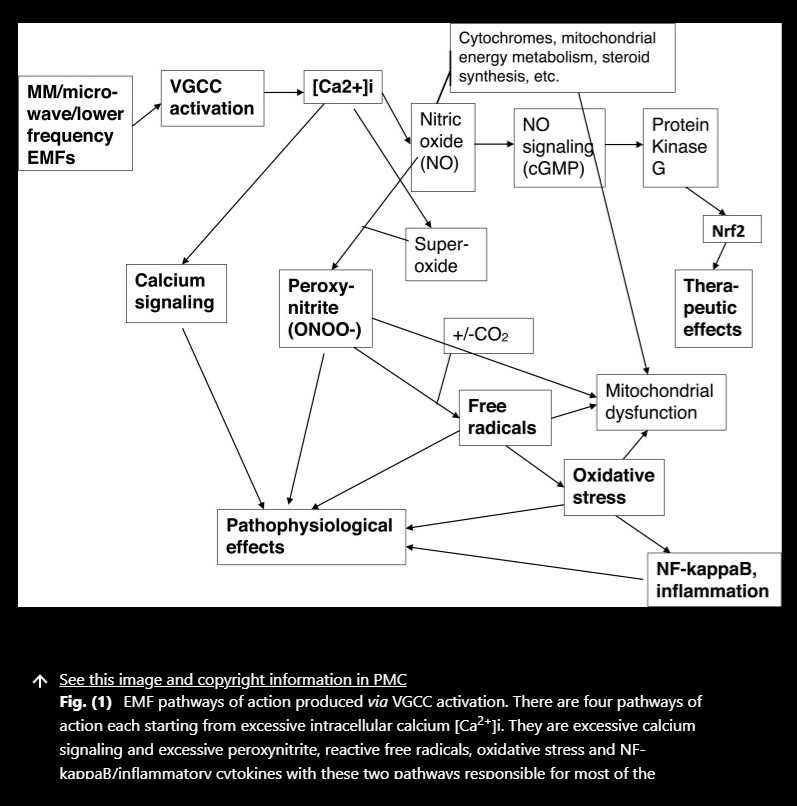
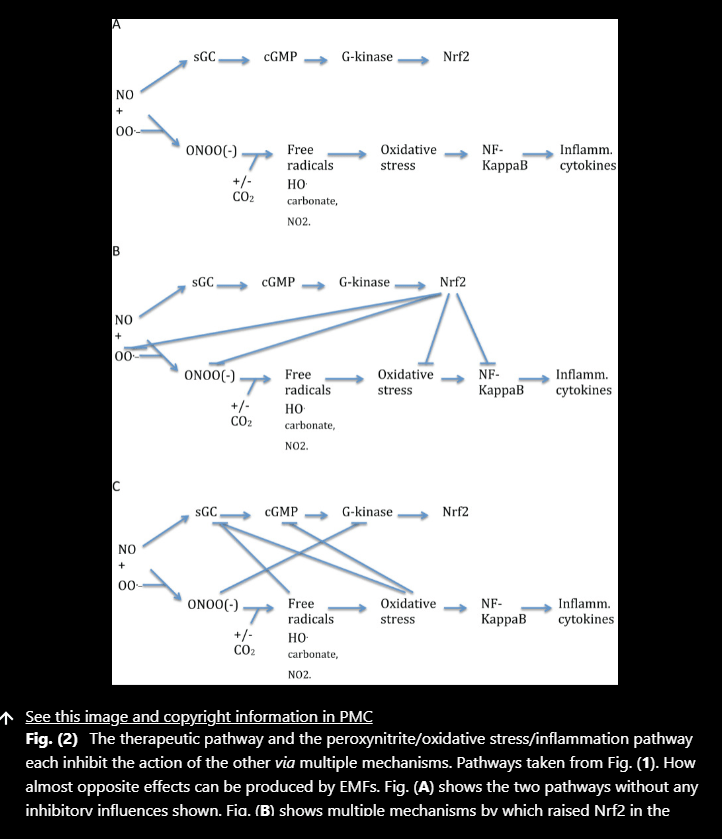
Electronically generated electromagnetic fields (EMFs), including those used in wireless communication such as cell phones, Wi-Fi and smart meters, are coherent, producing very high electric and magnetic forces, which act on the voltage sensor of voltage-gated calcium channels to produce increases in intracellular calcium [Ca2+]i. The calcium hypothesis of Alzheimer’s disease (AD) has shown that each of the important AD-specific and nonspecific causal elements is produced by excessive [Ca2+]i. [Ca2+]i acts in AD via excessive calcium signaling and the peroxynitrite/oxidative stress/inflammation pathway, which are each elevated by EMFs.An apparent vicious cycle in AD involves amyloid-beta protein (Aβ) and [Ca2+]i. Three types of epidemiology suggest EMF causation of AD, including early onset AD. Extensive animal model studies show that low intensity EMFs cause neurodegeneration, including AD, with AD animals having elevated levels of Aβ, amyloid precursor protein and BACE1. Rats exposed to pulsed EMFs every day are reported to develop universal or near universal very early onset neurodegeneration, including AD; these findings are superficially similar to humans with digital dementia. EMFs producing modest increases in [Ca2+]i can also produce protective, therapeutic effects. The therapeutic pathway and peroxynitrite pathway inhibit each other. A summary of 18 different findings is provided, which collectively provide powerful evidence for EMF causation of AD. The author is concerned that smarter, more highly pulsed “smart” wireless communication may cause widespread very, very early onset AD in human populations.
Keywords: Aβ and [Ca2+]i vicious cycle; Calcium hypothesis of Alzheimer’s disease; EMF safety guideline failure; animal models of Alzheimer’s disease; apoptotic and autophagic cell death; non-thermal electromagnetic field effects; the voltage sensor as the direct target of electromagnetic fields.
Copyright© Bentham Science Publishers; For any queries, please email at epub@benthamscience.net.
Figures
Similar articles
- Millimeter (MM) wave and microwave frequency radiation produce deeply penetrating effects: the biology and the physics.Pall ML.Rev Environ Health. 2021 May 26;37(2):247-258. doi: 10.1515/reveh-2020-0165. Print 2022 Jun 27.PMID: 34043892 Review.
- Microwave frequency electromagnetic fields (EMFs) produce widespread neuropsychiatric effects including depression.Pall ML.J Chem Neuroanat. 2016 Sep;75(Pt B):43-51. doi: 10.1016/j.jchemneu.2015.08.001. Epub 2015 Aug 21.PMID: 26300312 Review.
- Wi-Fi is an important threat to human health.Pall ML.Environ Res. 2018 Jul;164:405-416. doi: 10.1016/j.envres.2018.01.035. Epub 2018 Mar 21.PMID: 29573716
- Electromagnetic fields act via activation of voltage-gated calcium channels to produce beneficial or adverse effects.Pall ML.J Cell Mol Med. 2013 Aug;17(8):958-65. doi: 10.1111/jcmm.12088. Epub 2013 Jun 26.PMID: 23802593 Free PMC article. Review.
- Scientific evidence contradicts findings and assumptions of Canadian Safety Panel 6: microwaves act through voltage-gated calcium channel activation to induce biological impacts at non-thermal levels, supporting a paradigm shift for microwave/lower frequency electromagnetic field action.Pall ML.Rev Environ Health. 2015;30(2):99-116. doi: 10.1515/reveh-2015-0001.PMID: 25879308 Review.
Cited by
- Microwave Radiation and the Brain: Mechanisms, Current Status, and Future Prospects.Mumtaz S, Rana JN, Choi EH, Han I.Int J Mol Sci. 2022 Aug 18;23(16):9288. doi: 10.3390/ijms23169288.PMID: 36012552 Free PMC article. Review.
- Long-Term Impact of Using Mobile Phones and Playing Computer Games on the Brain Structure and the Risk of Neurodegenerative Diseases: Large Population-Based Study.Xiao Y, Zhang S, Ma Y, Wang S, Li C, Liang Y, Shang H.J Med Internet Res. 2025 Jan 28;27:e59663. doi: 10.2196/59663.PMID: 39874583 Free PMC article.
- Harmonizing Magnetic Mitohormetic Regenerative Strategies: Developmental Implications of a Calcium-Mitochondrial Axis Invoked by Magnetic Field Exposure.Franco-Obregón A.Bioengineering (Basel). 2023 Oct 10;10(10):1176. doi: 10.3390/bioengineering10101176.PMID: 37892906 Free PMC article. Review.
- High Frequency Repetitive Transcranial Magnetic Stimulation Improves Cognitive Performance Parameters in Patients with Alzheimer’s Disease – An Exploratory Pilot Study.Leblhuber F, Geisler S, Ehrlich D, Steiner K, Kurz K, Fuchs D.Curr Alzheimer Res. 2022;19(9):681-688. doi: 10.2174/1567205019666220920090919.PMID: 36125835
- Variables associated with cognitive function: an exposome-wide and mendelian randomization analysis.Zhao YL, Hao YN, Ge YJ, Zhang Y, Huang LY, Fu Y, Zhang DD, Ou YN, Cao XP, Feng JF, Cheng W, Tan L, Yu JT.Alzheimers Res Ther. 2025 Jan 7;17(1):13. doi: 10.1186/s13195-025-01670-5.PMID: 39773296 Free PMC article.
References
- Berridge M.J. Calcium hypothesis of Alzheimer’s disease. Pflugers Arch. 2010;459(3):441–449. doi: 10.1007/s00424-009-0736-1. – DOI – PubMed
- Alzheimer’s Association Calcium Hypothesis Workgroup. Calcium Hypothesis of Alzheimer’s disease and brain aging: A framework for integrating new evidence into a comprehensive theory of pathogenesis. Alzheimers Dement. 2017;13(2):178–182. – PubMed
- Bojarski L., Herms J., Kuznicki J. Calcium dysregulation in Alzheimer’s disease. Neurochem. Int. 2008;52(4-5):621–633. doi: 10.1016/j.neuint.2007.10.002. – DOI – PubMed
Show all 92 references
Original Source Link: https://pubmed.ncbi.nlm.nih.gov/35114921/

 Neighbors Organizing Against Trespassing Technology