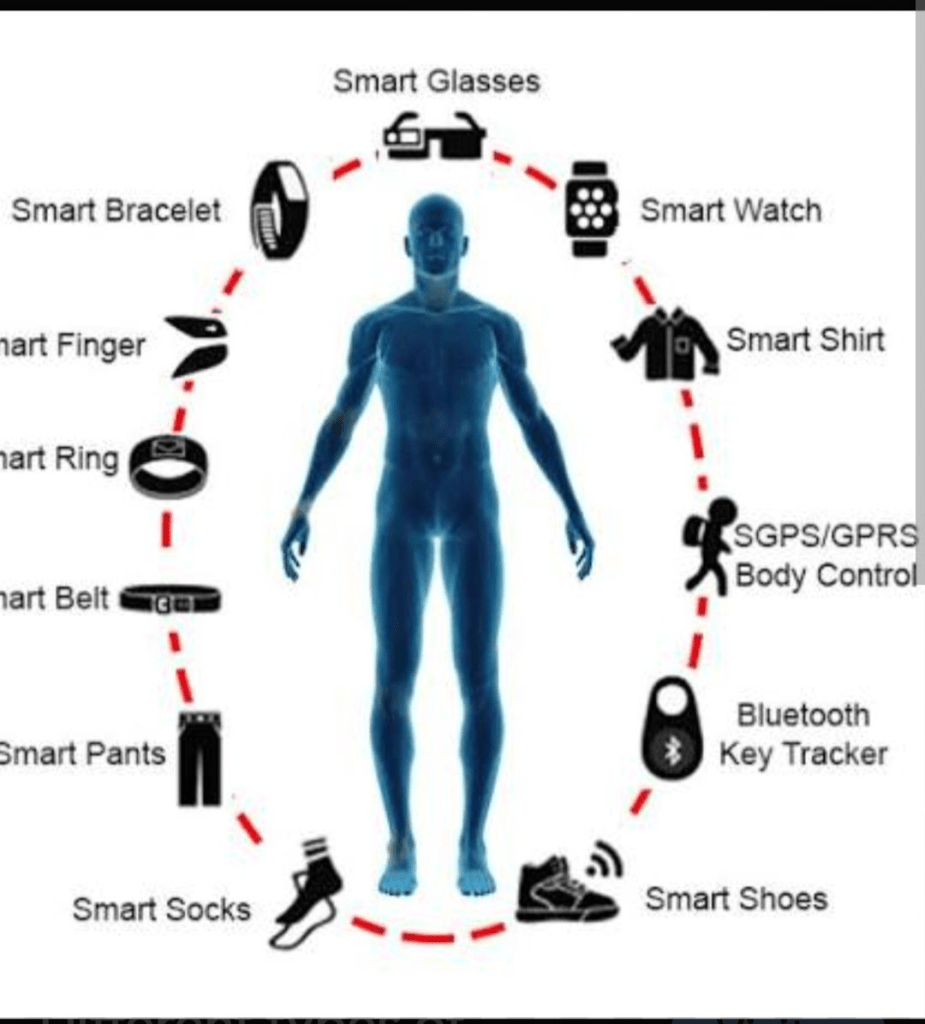
*Wearable
*Implantable
Wireless Body Area Network (WBAN) is a specialized network of miniaturized, wearable, or implantable sensors placed on or inside the human body.
A Wireless Body Area Network (WBAN) connects independent nodes (e.g. sensors and actuators) that are situated in the clothes, on the body or under the skin of a person.
The network typically expands over the whole human body and the nodes are connected through a wireless communication channel.
It monitors vital signs (heart rate, oxygen, temperature) and transmits data wirelessly to a central unit for healthcare applications, allowing for continuous, remote patient monitoring. Wikipedia
Key Aspects of WBANs:
Purpose:
Primarily used for healthcare, medical monitoring, and, to a lesser extent, sports and multimedia
Components:
Consists of multiple small body sensor units (BSUs) and a single body central unit (BCU) or data hub.
Technology:
Uses wireless technologies (e.g., WPAN) to send data to a, smartphone, or cloud, often following the IEEE 802.15.6 standard.
Features:
Operates in a limited range (30-50 meters) with low power consumption and high, continuous data transmission capabilities.
Applications:
Includes real-time health monitoring, detection of COVID-19 symptoms, and cancer cell identification.
Wikipedia
WBANs are often called Body Sensor Networks (BSNs) or Medical Body Area Networks (MBANs). Wikipedia
DANGERS OF WBANs
Wireless Body Area Network (WBAN) dangers primarily involve critical security threats that can lead to lifethreatening situations, including data tampering, eavesdropping, and Denial of Service (DoS) attacks that interrupt monitoring.
The open nature of wireless communication, combined with, energy-constrained sensors, makes them vulnerable to unauthorized access and malicious manipulation, compromising patient privacy and safety.
Primary WBAN Dangers & Security Threats:
Denial of Service (DoS) (Network Availability): Attackers can jam, disconnect, or disrupt communication between sensors and devices, preventing timely medical alerts.
Data Tampering & Manipulation:
Malicious actors can alter data sent to doctors, leading to incorrect diagnoses, improper treatment, or dangerous situations like unauthorized insulin injections.
Eavesdropping & Privacy Violations:
Because WBANs often use open wireless channels, sensitive medical data can be intercepted.
Device Compromise:
Sensor nodes are often easily captured, allowing attackers to extract security keys or inject false data.
Physical Risks:
If sensors are tampered with, they can cause bodily harm, such as overheating.
Interference & Network Congestion:
Inefficient, low-power networks can suffer from inter-WBAN interference, affecting the reliability of vital sign monitoring. ScienceDirect.com
Common Attack Types:
Spoofing & Impersonation:
An adversary acts as a trusted entity to gain access to the system.
Packet Replay Attacks: Captured data is re-sent to deceive medical staff.
Man-in-the-Middle (MITM) Attacks:
An attacker intercepts and modifies communications between the node and the receiver.
PubMed Central (PMC) (.gov) /
To mitigate these risks, robust encryption (like AES), secure key management, and strong authentication are essential, though challenging due to the limited power and processing capabilities of medical sensors.
PubMed Central (PMC) (.gov)
 Neighbors Organizing Against Trespassing Technology