Syntetic Teleparty this is Radio-Brain-Computer-Interface-Intents-Bone-Conduction (RBCIIBC)
The brain-computer interface (BCI), sometimes referred to as the brain-machine interface (BMI), is a direct communication path between the electrical activity of the brain and an external device, most commonly a computer or robotic limb. BCIs are often aimed at exploring, mapping, helping, enhancing, or restoring a person’s cognitive or sensorimotor functions. [1] BCI implementations range from non-invasive (EEG, MEG, EOG, MRI) and partially invasive (ECoG and endovascular) to invasive (microelectrode array), depending on how close the electrodes come to the brain tissue. [2]
Non-invasive BCIs
Human experiments have also been carried out using non-invasive neuroimaging technologies as interfaces. The vast majority of published works on BCIs involve non-invasive EEG-based BCIs. Non-invasive EEG-based technologies and interfaces are being used for a much wider range of applications. Although EEG-based interfaces are easy to wear and do not require surgery, they have a relatively low spatial resolution and cannot effectively use high frequency signals because the skull dampens the signals by scattering and blurring the electromagnetic waves produced by neurons. EEG-based interfaces also require some time and effort before each use session, while non-EEG and invasive interfaces do not require prior training in use. In general, the best BCI for each user depends on many factors.
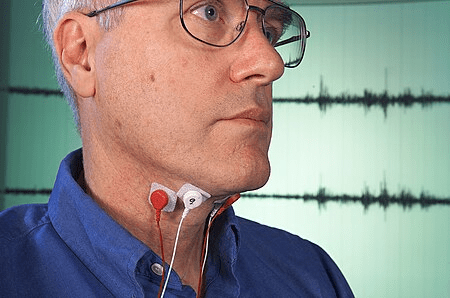
Subvocal recognition (SVR) is the process of subvocalizing and converting the detected results into a digital output, audio or text. [one]
A set of electrodes is attached to the skin of the throat and, without opening the mouth or making a sound, the computer recognizes the words.
US patents for silent communication technologies include:
U.S. Patent 6587729 “Device for audio transmission of speech using radio frequency auditory effect”,
U.S. Patent 5,159,703 Silent Subliminal Presentation System, [5]
US Patent 6011991 “Communication system and method, including the analysis of brain waves and / or the use of brain activity”, [6]
U.S. Patent 3,951,134 Apparatus and method for remote monitoring and alteration of brain waves. [7]
A throat microphone, also called a throat microphone, is a type of contact microphone that absorbs vibrations directly from the user’s throat using single or dual sensors worn around the neck. Sensors called transducers can pick up speech even in very noisy or windy environments, such as on a motorcycle or in a nightclub.
Noise-canceling headphones reduce unwanted ambient sounds with active noise control. This is different from passive headphones, which, if they reduce ambient sounds at all, use techniques such as soundproofing.
Active vibration control is the active application of a force equal to and opposite to that generated by external vibration. Thanks to this application, it is possible to maintain a precision industrial process on a virtually vibration-free platform.
A silent speech interface is a device that allows speech communication without the use of the sound that people make when they speak their own sounds. Thus, it is a kind of electronic lip reading. It works by having a computer identify the phonemes that a person is speaking from non-auditory sources of information about their speech movements. They are then used to recreate speech using speech synthesis.
Sources of information
Silent speech interface systems have been created using ultrasound and an optical camera inputting data on tongue and lip movements. [2] Electromagnetic devices are another method for tracking tongue and lip movements. [3] Another method is the detection of speech movements using electromyography of the muscles of the speech articulator and larynx. [4] [5] Another source of information is the resonant signals of the vocal tract, which are transmitted through BONE CONDUCTION and are called inaudible noises. [6] They have also been created as a brain-computer interface using brain activity in the motor cortex obtained with intracortical microelectrodes.

 Neighbors Organizing Against Trespassing Technology
One thought on “SYNTHETIC TELEPATHY”